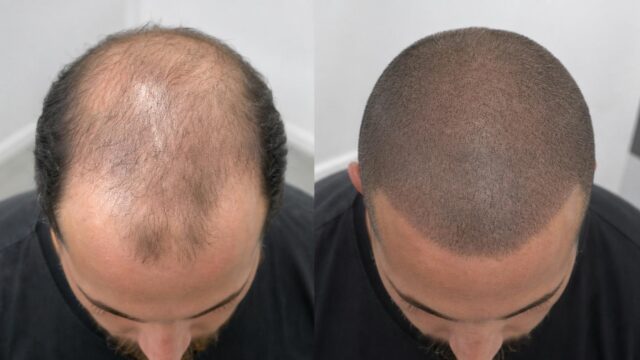

Losing your hair changes how you see yourself in the mirror, and the decision to do something about it is deeply personal. Two treatments dominate the conversation right now: surgical hair transplants and scalp micropigmentation (SMP). Each takes a fundamentally different approach to the same problem, and the right choice depends on factors most people don’t consider until they’re sitting in a consultation chair. The global hair restoration market reached $4.5 billion in 2023, with SMP accounting for a rapidly growing share of non-surgical revenue. Understanding the real pros and cons of a hair transplant versus SMP requires more than surface-level comparisons: it demands an honest look at how each procedure works, what it costs over a lifetime, and what kind of result you can actually expect.
Understanding Hair Transplant vs SMP: Core Differences
The distinction between these two treatments is as stark as the difference between reconstructive surgery and a tattoo. One grows real hair from relocated follicles. The other creates the illusion of hair density using pigment deposits in the scalp. Both produce convincing results, but the biological mechanisms, recovery timelines, and long-term maintenance profiles couldn’t be more different.
Surgical Restoration: How Hair Transplants Work
A hair transplant relocates living follicular units from a donor area, typically the back and sides of the head, to thinning or bald regions. The two dominant techniques are FUE (Follicular Unit Extraction) and DHI (Direct Hair Implantation). In FUE, a surgeon uses a micro-punch tool measuring 0.6mm to 1.0mm in diameter to extract individual grafts, which are then implanted into micro-channels created at the recipient site. DHI uses a specialized Choi pen to implant grafts directly, controlling depth, angle, and direction simultaneously.
The biological process that follows is what makes transplants unique. Relocated follicles trigger a cascade of healing responses: neovascularization establishes blood supply to the grafts within 7 to 10 days, and the transplanted hair enters a shedding phase around weeks 3 to 6 before new growth begins at months 3 to 4. Final density is typically visible by month 12 to 18. According to the International Society of Hair Restoration Surgery (ISHRS), a well-executed procedure achieves 85% to 95% graft survival.
Cosmetic Camouflage: The Scalp Micropigmentation Process
SMP is a cosmetic procedure where a technician deposits specialized pigment into the upper dermis of the scalp at a depth of 0.5mm to 1.5mm. Each dot replicates the appearance of a hair follicle, creating the visual effect of a closely shaved head or adding the illusion of density between existing hairs.
A typical SMP treatment requires 2 to 4 sessions spaced about 7 to 10 days apart, with each session lasting 2 to 5 hours depending on coverage area. The pigments used are formulated specifically for scalp application and differ from traditional tattoo ink in particle size and composition, which affects how they fade over time. No anesthesia beyond topical numbing cream is required, and there’s essentially zero downtime between sessions.
The Pros and Cons of Surgical Hair Restoration
Advantages of Real Hair Growth
The single greatest advantage of a hair transplant is that the result is biological. You grow real hair that you can wash, cut, style, and run your fingers through. This tactile and visual authenticity is something no cosmetic procedure can replicate. For patients with Norwood 2 to 4 hair loss who retain a strong donor area, transplants can restore a natural hairline that ages with them.
Transplanted follicles are typically resistant to DHT, the hormone responsible for androgenetic alopecia, because they’re harvested from genetically resistant zones. This means the results are effectively permanent. A single procedure can relocate 2,000 to 5,000 grafts, and patients who track progress with monthly photos under consistent lighting often see the most dramatic transformation between months 8 and 14.
Limitations: Cost, Recovery, and Scarring
Surgical restoration is expensive. A quality FUE or DHI procedure ranges from $2,000 to $15,000 depending on geography and graft count. Turkey has become a major destination for hair transplants, with clinics in Istanbul’s Şişli and Mecidiyeköy neighborhoods offering procedures at a fraction of Western European prices while maintaining high clinical standards. Estenove, for example, provides FUE, DHI, and stem cell transplant options in this medical corridor, just minutes from Istanbul Airport.
Recovery is real. Expect redness and scabbing for 10 to 14 days, restrictions on exercise for 3 to 4 weeks, and a “shock loss” phase that can be psychologically difficult. FUE leaves tiny dot scars in the donor area, while the older FUT strip method creates a linear scar. Patients with advanced hair loss (Norwood 5 to 7) may not have sufficient donor hair for satisfying coverage, which is a hard biological limit no surgeon can overcome.
Evaluating SMP Pros and Cons for Non-Surgical Density
Immediate Results and Low Maintenance
SMP delivers visible results after the very first session. There’s no waiting 12 months to see whether grafts survived. For men who prefer a buzzed or shaved aesthetic, the effect is remarkably convincing within days. The procedure also works for scar camouflage: both FUE dot scars and FUT linear scars respond well to pigment coverage.
Cost is significantly lower than surgery. A full SMP treatment typically runs $1,500 to $4,000 for complete scalp coverage. There’s no surgical risk, no general anesthesia, and no recovery period. You can return to work the next day. For people who want a defined hairline without committing to surgery, SMP offers a practical, low-risk path to improved appearance.
The 2D Limitation and Fading Over Time
SMP’s biggest weakness is that it creates a two-dimensional illusion. The dots replicate the look of follicles, but there’s no actual hair growing. Under certain lighting conditions or at very close range, the effect can appear flat. This is less of an issue for men who keep their heads shaved, but for those hoping to blend SMP with longer existing hair, the illusion has limits.
Fading is inevitable. Most SMP treatments begin to lighten noticeably within 3 to 5 years, and touch-up sessions are required to maintain the look. UV exposure accelerates fading, so daily sunscreen application on the scalp becomes a permanent part of your routine. Over a 20-year span, the cumulative cost of touch-ups can approach or even exceed the one-time cost of a transplant.
Choosing the Best Hair Loss Solution: SMP or Transplant?
Factors to Consider: Budget, Lifestyle, and Hair Loss Stage
The best approach depends on three variables: your budget right now, your tolerance for downtime, and how much donor hair you have left. Here’s a practical framework:
- Norwood 1-3 with strong donor area: A transplant offers the most natural, lasting result. You have enough donor hair for meaningful coverage.
- Norwood 5-7 with depleted donor area: SMP may be the more realistic option, since transplant results at this stage often look thin and unconvincing.
- Budget under $2,000: SMP is your entry point. A transplant at this price point carries serious quality risks.
- Lifestyle requiring zero downtime: SMP wins. No recovery period means no time away from work or social obligations.
- Desire for real, touchable hair: Only a transplant delivers this. SMP cannot replicate the physical sensation of hair.
Ask yourself one direct question: do you want real hair or the appearance of hair? Your answer simplifies the decision considerably.
Combining Both Treatments for Maximum Density
A growing number of patients are combining transplants with SMP, and the results can be striking. The strategy works like this: a transplant restores real hair in the frontal zone and midscalp, while SMP fills in the crown and adds the illusion of density between transplanted grafts. This hybrid approach is particularly effective for patients with moderate donor supply who want full-head coverage.
The typical sequence is to complete the transplant first, wait 12 to 18 months for full growth, then assess which areas benefit from SMP enhancement. This combination can reduce the total number of grafts needed by 20% to 30%, lowering surgical costs while still producing a convincing full-head result.
FAQ
SMP ranges from $1,500 to $4,000 for full coverage, while hair transplants cost $2,000 to $15,000 depending on graft count and location. Factor in SMP touch-ups every 3 to 5 years when calculating lifetime cost.
Yes. Many patients use SMP to camouflage transplant scars, add density between grafts, or fill areas where donor supply was insufficient. Wait at least 6 to 12 months post-transplant before starting SMP.
SMP typically lasts 3 to 5 years before requiring a touch-up. A hair transplant is permanent: once grafts establish blood supply and begin growing, the results last a lifetime, though surrounding native hair may continue thinning.
Neither is universally better. SMP is faster, cheaper, and non-invasive. A transplant produces real, permanent hair. The right choice depends on your hair loss stage, budget, and whether you prioritize the look of density or actual hair growth. For many patients, the smartest move is combining both.