
Choosing between two of the most advanced hair transplant techniques available today can feel overwhelming, especially when both promise natural-looking, permanent results. DHI and Sapphire FUE share the same foundational principle: extracting individual follicular units from a donor area and transplanting them to thinning or balding zones. Yet the instruments used, the implantation protocols, and the recovery profiles differ in ways that genuinely matter for your outcome.
The global hair transplant market was valued at approximately $5.4 billion in 2023, according to Grand View Research, and Turkey accounts for roughly 25% of all procedures performed worldwide. That concentration of expertise means patients have access to surgeons who perform hundreds of these operations annually, refining both DHI and Sapphire FUE techniques with each case. But volume alone does not answer the question every prospective patient asks: which method is right for me?
This comparison breaks down the mechanics, results, recovery, cost, and ideal candidate profiles for each technique. The goal is not to declare a universal winner but to give you the specific information you need to make a confident, informed decision with your surgeon.
Understanding the Core Differences: DHI vs Sapphire FUE
Both DHI and Sapphire FUE fall under the broader umbrella of Follicular Unit Extraction. The extraction phase is virtually identical: a micro-punch tool between 0.6mm and 0.9mm in diameter removes individual grafts from the occipital (back) region of the scalp. Where the two methods diverge is in what happens after extraction, specifically how recipient channels are created and how grafts are placed.
Understanding this divergence is critical because the implantation phase directly affects graft survival rate, angle control, density potential, and healing speed. A 2021 study published in the Journal of Cosmetic Dermatology found that implantation technique accounted for up to 15% variance in graft survival between clinics using the same extraction method. The instrument in the surgeon’s hand during implantation, then, is not a minor detail.
The Direct Hair Implantation (DHI) Method and Choi Pen Innovation
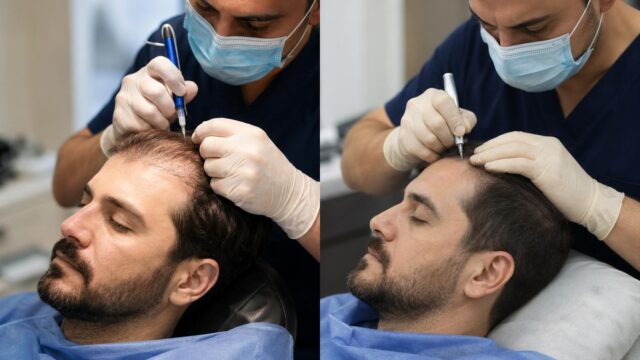
DHI uses a patented instrument called the Choi Implanter Pen, a hollow needle device with a spring-loaded plunger. The pen allows the surgeon to load a single graft, puncture the recipient site, and deposit the follicle in one fluid motion. This eliminates the traditional two-step process of first creating channels with a blade and then placing grafts into those channels separately.
The Choi pen needle typically ranges from 0.5mm to 1.5mm in diameter, selected based on the thickness of the individual graft. Because the surgeon controls depth, angle, and direction simultaneously, DHI offers exceptional precision for hairline work. According to the International Society of Hair Restoration Surgery (ISHRS), experienced DHI practitioners can achieve placement angles as precise as 10 to 15 degrees relative to the scalp surface, closely mimicking the natural emergence angle of native hair.
One practical limitation: DHI is a slower process. Each graft requires individual loading into the pen, and most surgical teams use 2 to 6 pens in rotation. A typical session of 3,000 grafts can take 6 to 8 hours. The technique also demands a highly skilled team, as each assistant must load pens without damaging the delicate follicular units.
The Sapphire Blade FUE Technique: Precision with Precious Stones
The sapphire blade FUE technique replaces the standard steel slit blade with one crafted from genuine sapphire crystal. These blades measure as small as 1.0mm to 1.3mm at the tip and maintain their sharpness far longer than steel equivalents, which dull measurably after approximately 10 to 15 incisions.
The practical benefit is cleaner, smaller micro-channels in the recipient area. Sapphire blades produce V-shaped incisions rather than the U-shaped channels typical of steel, resulting in less tissue trauma and tighter wound closure. A 2020 comparative study by Dr. Kerem Bıçakçı’s team in Istanbul demonstrated that sapphire-blade incisions showed 18% less edema (swelling) at the 72-hour mark compared to steel-blade incisions.
After channel creation, trained technicians place each graft into the pre-made sites using fine-tipped forceps. This two-step process (channel creation followed by graft placement) allows the surgeon to map out the entire recipient zone before any grafts are inserted, giving a bird’s-eye view of density distribution. For large sessions exceeding 4,000 grafts, this macro-level planning is a significant advantage.
Comparing Sapphire FUE vs DHI Results and Recovery
Results and recovery are the two factors patients care about most, and for good reason. A procedure that delivers slightly better density but requires three weeks of downtime may not suit someone who needs to return to work within ten days. Comparing Sapphire FUE vs DHI results requires looking at both the short-term healing window and the long-term growth trajectory.
Healing Timelines and Post-Operative Care
The first 72 hours after either procedure involve swelling, redness, and scab formation. DHI patients typically experience slightly less initial swelling in the recipient area because the Choi pen creates smaller entry points than even sapphire blades. However, the difference is marginal: most patients report that swelling peaks on day 3 and subsides by day 5 to 7 regardless of technique.
Scab shedding follows a predictable timeline for both methods:
- Days 1 to 3: tiny crusts form around each graft site
- Days 7 to 10: gentle washing begins to loosen and remove scabs
- Days 10 to 14: most scabs have shed; redness remains
- Weeks 3 to 4: redness fades significantly; the scalp appears mostly normal
Post-operative care protocols are nearly identical. Patients sleep at a 45-degree angle for the first five nights, avoid direct sun exposure for four weeks, and refrain from strenuous exercise for 14 days. Saline spray is applied every 30 to 60 minutes during waking hours for the first three days to keep grafts hydrated.
One notable difference: because DHI does not require pre-made channels, there is no need to shave the entire recipient area. This makes DHI popular among patients, particularly women, who want to conceal the procedure under existing hair. Sapphire FUE typically requires shaving the recipient zone for the surgeon to create channels with full visibility.
Long-Term Hair Density and Natural Growth Patterns
Graft survival rates for both techniques hover between 90% and 95% in the hands of experienced surgeons. The real differentiator in long-term results is density per square centimeter and the naturalness of growth direction.
DHI excels at packing grafts closely together because the Choi pen can place follicles between existing hairs without damaging them. Clinics specializing in DHI report achieving 50 to 60 grafts per square centimeter in the frontal hairline zone. This makes DHI particularly effective for patients who still have some native hair and want to increase density without sacrificing what remains.
Sapphire FUE, by contrast, performs exceptionally well for covering larger bald areas where no existing hair needs protection. The pre-mapped channel approach allows surgeons to distribute 4,000 to 5,500 grafts across a wide surface area in a single session, achieving uniform coverage that would take multiple DHI sessions to match.
Both techniques produce hair that grows in natural patterns when performed correctly. Expect initial shedding (shock loss) between weeks 2 and 6, followed by new growth starting around month 3 to 4. By month 8, approximately 70% of transplanted hairs are visible. Full results are typically assessed at 12 to 18 months.
Track your progress by photographing the hairline and crown under consistent lighting on the first day of each month. Use the same room, same angle, and same camera distance for reliable comparison.
Determining Which is Better: DHI or Sapphire FUE for Your Needs
The question of which is better, DHI or FUE with sapphire blades, does not have a one-size-fits-all answer. The right choice depends on the extent of your hair loss, your density goals, whether you need to keep the procedure discreet, and your budget.
Suitability Based on Graft Count and Degree of Hair Loss
A helpful framework:
| Factor | DHI Preferred | Sapphire FUE Preferred |
|---|---|---|
| Graft count | Under 3,500 grafts | 3,000 to 5,500+ grafts |
| Hair loss stage | Norwood 2-4 | Norwood 4-6 |
| Existing hair | Dense native hair present | Minimal or no native hair |
| Primary goal | Density in small zones | Coverage across large areas |
| Shaving required | No (unshaven DHI possible) | Yes, usually full shave |
| Session duration | 6-8 hours | 5-7 hours |
Patients with early-stage thinning along the hairline or temples often benefit most from DHI’s precision placement. The Choi pen’s ability to work between existing follicles without disturbing them is a genuine advantage for Norwood 2 and 3 patients.
For patients with extensive baldness across the crown and mid-scalp, Sapphire FUE’s capacity to handle high graft counts in a single session makes it the more practical choice. Attempting 5,000 grafts with DHI would extend the procedure to 10+ hours, increasing fatigue for both the surgical team and the patient, which can compromise graft handling quality.
Some clinics, including Estenove in Istanbul, offer hybrid approaches: using DHI for the hairline where precision matters most and Sapphire FUE for the crown where coverage area is the priority. This combined strategy can deliver the best of both worlds for patients in the Norwood 3 to 5 range.
Cost Analysis and Choosing the Right Procedure
DHI typically costs 15% to 30% more than Sapphire FUE for the same graft count. The price premium reflects the specialized Choi pens (which are single-use or require expensive sterilization), the need for more technicians, and the longer procedure time.
In Turkey, pricing for Sapphire FUE generally ranges from $1,800 to $3,500 for packages including hotel, transfers, and medication. DHI packages at reputable clinics run $2,500 to $4,500. In the UK, US, or Western Europe, both procedures cost three to five times more for equivalent graft counts.
When evaluating cost, consider these factors beyond the sticker price:
- Number of sessions needed: if your hair loss requires 5,000+ grafts, Sapphire FUE may accomplish this in one session versus two for DHI
- Aftercare inclusions: reputable clinics include PRP therapy, medications, and follow-up consultations
- Surgeon credentials: verify ISHRS membership and ask to see before-and-after galleries from the specific surgeon, not just the clinic
- Ghost surgery risk: ask directly whether the named surgeon performs the entire procedure or delegates to technicians
Request a video consultation before committing. A responsible clinic will assess your donor area density (ideally 60+ follicular units per square centimeter for a good candidate), discuss realistic expectations, and recommend the technique that fits your anatomy rather than defaulting to the most expensive option.
FAQ
Sapphire FUE is not typically the more expensive option: DHI usually carries the higher price tag. However, Sapphire FUE does cost more than standard steel-blade FUE, and the premium is justified. The smaller, sharper incisions reduce healing time by 1 to 3 days on average and produce less scarring. For patients needing 3,000+ grafts, the improved channel precision translates to better graft survival across large transplant zones.
Both techniques leave minimal scarring compared to older strip (FUT) methods. DHI creates the smallest possible entry points since the Choi pen combines channel creation and placement in one step. Sapphire FUE’s V-shaped channels also heal with very little visible scarring. By month 3, scarring from either method is virtually undetectable to the naked eye. The donor area scarring is identical for both since they use the same extraction method.
The extraction phase is the same. The key difference lies in implantation. DHI uses a Choi Implanter Pen that creates the channel and places the graft simultaneously. Sapphire FUE uses sapphire crystal blades to pre-create all recipient channels first, then grafts are placed into those channels with forceps. DHI offers more angle control per graft; Sapphire FUE allows better overall density mapping for large sessions.
DHI achieves higher density in small, targeted areas: up to 60 grafts per square centimeter in the hairline zone. Sapphire FUE delivers more uniform density across larger surface areas because the surgeon can plan the entire channel map before placing any grafts. For maximum density in a specific zone like the frontal hairline, DHI has the edge. For balanced density across the full scalp, Sapphire FUE is often the stronger choice.