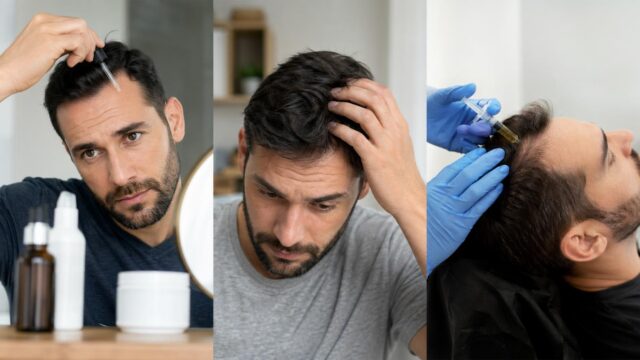

Hair loss affects roughly 85% of men by age 50 and an increasing number of women before 40, according to the American Hair Loss Association. Choosing between PRP, minoxidil, and finasteride is one of the most common decisions patients face, yet the real-world differences in cost and results remain poorly understood. Each treatment operates through a distinct biological pathway, carries its own risk profile, and demands a different financial commitment over time. Whether you are weighing a single therapy or planning a combination protocol, the breakdown below gives you the clinical data and dollar figures you need to decide with confidence. Track your own progress by photographing your hairline and part under consistent lighting once a month; objective before-and-after records are the most reliable way to measure what is actually working.
Mechanisms of Action: How PRP vs Minoxidil vs Finasteride Work
Platelet-rich plasma therapy begins with a standard blood draw of approximately 10-20 mL. The sample is centrifuged at 1,500 RPM for roughly 8-10 minutes to isolate a platelet concentration three to five times above baseline. Those concentrated growth factors, including PDGF, VEGF, and TGF-beta, are then injected directly into the scalp at depths of 1.0-1.5 mm using a 30-gauge needle, triggering a cascade of healing responses that reactivate dormant follicles and extend the anagen growth phase.
Minoxidil (sold under the brand name Rogaine and many generics) is a topical vasodilator. Applied twice daily at a 5% concentration for men or 2% for women, it widens blood vessels around the follicle, increasing oxygen and nutrient delivery. Its mechanism is partially potassium-channel dependent, which is why it works regardless of hormonal status.
Finasteride (Propecia) takes a hormonal approach. This oral 1 mg tablet inhibits the type II 5-alpha-reductase enzyme, reducing scalp dihydrotestosterone (DHT) levels by roughly 60-70%. Because DHT is the primary androgen responsible for miniaturizing hair follicles in androgenetic alopecia, blocking it can halt progression and, in many cases, reverse thinning.
Topical and Oral Stimulants vs Biological Growth Factors
The core distinction is simple: minoxidil and finasteride are pharmaceutical agents you take daily, while PRP is a biologic procedure performed in a clinical setting every four to six weeks during the loading phase. Pharmaceuticals require ongoing compliance; miss a few weeks of finasteride and DHT rebounds. PRP’s growth factors work through a concentrated burst of tissue repair signaling, meaning its effects are session-dependent rather than dose-dependent.
Expected Results in Hair Loss Treatment Comparison 2026
Recent data from a 2024 meta-analysis published in the Journal of Cosmetic Dermatology found that PRP monotherapy produced a mean hair density increase of 33.6 hairs per cm² after six months. Finasteride trials consistently show that roughly 83-90% of men maintain or increase hair count at two years, according to long-term studies cited by the International Society of Hair Restoration Surgery. Minoxidil delivers visible regrowth in about 40-60% of users, with peak results typically appearing around month four to six.
Success Rates and Regrowth Timelines for Each Method
- PRP: Initial shedding possible in weeks 1-3. Noticeable density improvement at months 3-4. Optimal results after 4-6 sessions spaced monthly, then maintenance every 6-12 months.
- Minoxidil 5%: Shedding phase in weeks 2-6 (a positive sign of follicle cycling). Visible regrowth at months 4-6. Continuous daily use required indefinitely; stopping reverses gains within 3-6 months.
- Finasteride 1 mg: Subtle improvements at month 3. Significant density gains at months 6-12. Long-term maintenance requires daily dosing; cessation leads to gradual loss of benefits over 6-12 months.
Patients who photograph their hairline monthly under the same lighting conditions will notice the timeline differences clearly. PRP tends to improve hair caliber (thickness) before density, while minoxidil often shows vellus hair sprouting first.
Cost Analysis: PRP Hair Treatment Cost vs Long-Term Medication
The global PRP market for hair restoration was valued at approximately $540 million in 2024 and is projected to grow at a 12.3% CAGR through 2030, reflecting surging patient demand. But what does that mean for your wallet?
Upfront Clinical Fees vs Monthly Prescription Expenses
| Treatment | Year 1 Cost (USD) | Year 2-5 Annual Cost | 5-Year Total |
|---|---|---|---|
| PRP (4-6 sessions + 1-2 maintenance) | $2,400 – $4,800 | $600 – $1,200 | $4,800 – $9,600 |
| Minoxidil 5% (generic, daily) | $120 – $300 | $120 – $300 | $600 – $1,500 |
| Finasteride 1 mg (generic, daily) | $60 – $240 | $60 – $240 | $300 – $1,200 |
PRP hair treatment cost is front-loaded: the initial loading phase is expensive, but maintenance drops sharply. Minoxidil and finasteride are cheap per month but never stop. Over a decade, the cumulative spend on daily medication narrows the gap with PRP more than most patients expect. For those considering PRP abroad, clinics in Istanbul’s Sisli and Nisantasi medical districts, just 30-40 minutes from Istanbul Airport, offer sessions starting around $150-$300 per session, a fraction of U.S. or U.K. pricing.
Safety Profiles and Finasteride Side Effects
Minoxidil’s most common complaints are scalp irritation, dryness, and unwanted facial hair growth in women using higher concentrations. Systemic absorption is minimal at recommended doses.
Finasteride side effects receive the most scrutiny. Clinical trials report sexual side effects (decreased libido, erectile difficulty) in 1.3-3.8% of users. A small subset of men describe persistent symptoms after discontinuation, a phenomenon sometimes called post-finasteride syndrome, though large-scale epidemiological studies have not confirmed a causal mechanism. Patients should discuss personal risk factors, including family history of depression or hormonal sensitivity, with their prescribing physician before starting.
PRP carries the lowest systemic risk because the injected material is autologous (your own blood). Localized side effects include mild swelling, bruising, and tenderness lasting 24-48 hours. Infection risk is negligible when clinics follow proper sterilization protocols, including 70% isopropyl alcohol skin preparation and single-use needle kits.
Managing Risks and Choosing the Right Protocol for Your Health
If you are concerned about finasteride side effects, a topical finasteride formulation (0.025-0.1%) applied directly to the scalp is gaining traction as a way to reduce systemic DHT suppression while still targeting the follicle. Ask your dermatologist whether this option fits your Norwood stage and health profile.
The Synergy Strategy: Combining Treatments for Maximum Efficacy
The strongest clinical outcomes come from combination protocols. A 2023 study in Dermatologic Surgery showed that PRP plus finasteride produced 44% greater hair density improvement than either treatment alone at 12 months. Adding minoxidil as a third agent creates a triple-action approach: DHT suppression, vascular stimulation, and growth-factor activation all working on different pathways simultaneously.
A practical combination schedule might look like this: daily oral or topical finasteride, twice-daily minoxidil application, and PRP sessions every four to six weeks for the first six months before transitioning to quarterly maintenance. Clinics like Estenove in Istanbul often integrate PRP sessions into post-transplant recovery plans for patients who have undergone FUE or DHI procedures, accelerating graft survival and native hair thickening in a single protocol.
FAQ
Yes. PRP is frequently administered before, during, and after transplant surgery to improve graft take rates and accelerate healing. Studies show PRP-treated grafts achieve up to 15% higher survival compared to untreated grafts.
Large-scale studies tracking patients for five to ten years show that finasteride remains effective and well-tolerated for the majority of users. The 1-4% incidence of sexual side effects typically resolves upon discontinuation. Regular blood work and check-ins with your physician are recommended annually.
PRP sessions in Turkey typically range from $150 to $300 per session, compared to $500-$1,500 in the United States and $400-$800 in the United Kingdom. Istanbul’s concentrated medical infrastructure in neighborhoods like Sisli keeps overhead low without sacrificing clinical standards.
Neither is universally superior. PRP tends to produce thicker, higher-caliber hair and does not require daily application, but it costs more upfront. Minoxidil is affordable and accessible over the counter, yet demands lifelong daily compliance. For many patients, using both together delivers the best outcome.