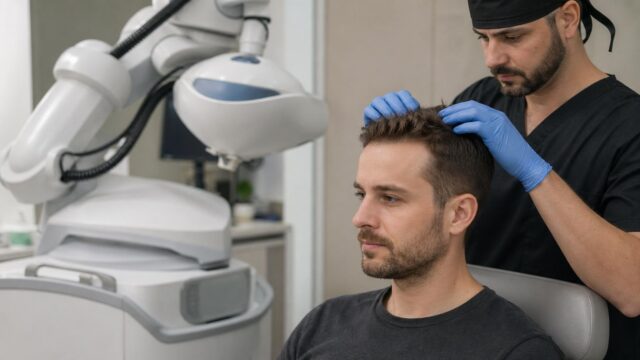
The ARTAS system has been marketed as the future of hair restoration since its FDA clearance in 2011, and the global robotic hair transplant market reached an estimated $215 million in 2023. But hype and clinical reality don’t always align. For patients weighing whether a robotic hair transplant is truly worth the premium price tag, the answer depends on your specific hair loss pattern, budget, and expectations. The technology has genuine strengths, but it also carries limitations that most marketing materials conveniently omit. Here’s an honest assessment of what the ARTAS system actually delivers and where it falls short.
Understanding ARTAS Robotic Hair Transplant Technology
The ARTAS system is a robotic arm guided by artificial intelligence, designed to assist surgeons during follicular unit extraction (FUE) procedures. Developed by Restoration Robotics (now part of Venus Concept), the machine uses a stereoscopic vision system with multiple cameras to map the donor area, typically the back and sides of the scalp. It then identifies individual follicular units and extracts them using a dual-punch mechanism: a sharp outer punch scores the skin at approximately 1.0mm-1.2mm depth, while an inner blunt punch dissects the graft from surrounding tissue.
The system doesn’t perform the entire transplant. It handles the harvesting phase only. Graft placement into the recipient area still requires a skilled surgeon’s hand, which is a critical distinction many patients overlook.
How the Robotic FUE Hair Transplant Process Works
The procedure begins with the patient sitting in a specialized chair with their head positioned in a tensioning device that stretches the donor scalp taut. The robot’s cameras capture high-resolution images at 60 frames per second, creating a 3D model of the donor zone. The physician sets parameters including punch depth (typically 4.0mm-5.5mm), angle of extraction, and spacing between harvested grafts to preserve donor density.
Each extraction takes roughly 1-3 seconds per graft. A typical session harvests 1,500-2,500 grafts over 4-6 hours. The surgeon monitors the process on a screen and can adjust settings in real time if transection rates increase or the robot encounters resistance.
The Role of AI in Graft Selection and Harvesting
The ARTAS algorithm analyzes hair density, angle, direction, and follicular unit groupings across the entire donor area before making a single extraction. It calculates optimal spacing to avoid the “moth-eaten” appearance that can result from over-harvesting in concentrated zones. According to clinical data published by Bernstein Medical, the system’s AI maintains transection rates between 6-9%, which is competitive with experienced manual surgeons who typically achieve 5-10%.
The machine also tracks each extraction site, ensuring even distribution across the donor zone. This mapping capability is genuinely impressive and difficult for even the most skilled human hand to replicate with the same mathematical precision.
ARTAS vs Manual FUE: Comparing Precision and Speed
The debate between ARTAS and manual FUE isn’t straightforward. Each method has measurable advantages depending on the clinical scenario, the surgeon’s experience level, and the patient’s hair characteristics.
Advantages of Robotic Extraction Over Human Hand
- Consistency over long sessions: A surgeon’s hand fatigues after 3-4 hours. The robot maintains identical punch depth and angle from graft #1 to graft #2,500.
- Donor area mapping: The AI distributes extractions mathematically, preserving a natural-looking donor zone.
- Reduced human error: For less experienced surgeons, the robot acts as a safety net against high transection rates.
- Smaller punch size: The ARTAS uses punches as small as 0.9mm, potentially reducing scarring compared to larger manual punches.
Limitations and When Manual FUE Might Be Superior
The ARTAS system cannot harvest body hair, which limits options for patients with depleted scalp donor areas. It also struggles with curly or afro-textured hair: the algorithm was primarily trained on straight-to-wavy hair types, and transection rates climb significantly with tightly coiled follicles.
Manual FUE performed by a highly experienced surgeon often achieves better results in several scenarios. Surgeons can adjust their technique in real time based on tactile feedback, something the robot simply cannot replicate. For beard, chest, or body hair grafts, manual extraction remains the only viable option. Clinics like Estenove, which specialize in manual FUE and DHI techniques, often achieve transection rates below 5% with experienced surgical teams, matching or exceeding robotic precision.
Evaluating ARTAS Hair Transplant Results and Recovery
ARTAS hair transplant results are generally comparable to skilled manual FUE in terms of final density and naturalness. Published studies show graft survival rates of 85-95% with the ARTAS system, which aligns closely with manual FUE outcomes. The real differentiator isn’t the final result: it’s the consistency of achieving that result across varying surgeon skill levels.
Recovery follows the standard FUE timeline. Patients can expect pinpoint scabs in the donor area that heal within 7-10 days. Swelling peaks around day 3-4. Most patients return to desk work within 3-5 days.
Expected Timeline for Growth and Density
- Weeks 1-4: Transplanted hairs shed (shock loss). This is normal and expected.
- Months 2-3: Donor area fully heals. New growth begins as fine, thin hairs.
- Months 4-6: Visible improvement. Approximately 30-40% of transplanted grafts are actively growing.
- Months 8-10: Significant density becomes apparent. Hair thickens and matures.
- Month 12-18: Final results. Full density and natural texture achieved.
Track your progress by photographing your hairline and crown monthly under consistent lighting, ideally the same room, same angle, and same time of day.
Investment Analysis: Robotic Hair Transplant Cost and Value
Robotic hair transplant cost runs significantly higher than manual FUE. In the United States, ARTAS procedures typically range from $10,000-$20,000 for 2,000-2,500 grafts. The same graft count via manual FUE at a reputable US clinic costs $8,000-$15,000. In Turkey, where medical tourism drives competitive pricing, manual FUE procedures for similar graft counts range from $2,500-$5,000 at accredited clinics.
Factors Influencing the Premium Pricing of ARTAS
The price premium stems from the equipment itself: the ARTAS system costs clinics approximately $300,000-$500,000, with ongoing maintenance and licensing fees. These costs get passed directly to patients. The machine also requires dedicated floor space and specially trained technicians.
The question isn’t whether the technology works: it does. The question is whether the marginal improvement in harvesting consistency justifies paying 30-100% more than a skilled manual surgeon would charge. For most patients, the data suggests it doesn’t. A 2021 comparative study in the Journal of Cosmetic Dermatology found no statistically significant difference in patient satisfaction or graft survival between ARTAS and experienced manual FUE surgeons.
Final Verdict: Is the Robotic Approach Right for You?
The ARTAS system is a genuinely sophisticated tool that excels at one specific task: consistent follicle harvesting from straight-to-wavy hair. If you’re considering a robotic procedure, it makes the most sense when your local surgeon options are limited in experience, or when you specifically value the mathematical precision of donor area management.
For the majority of hair transplant candidates, however, a skilled manual FUE or DHI surgeon delivers equivalent or superior results at a lower cost, particularly if you’re open to traveling to established medical tourism destinations like Istanbul’s Sisli or Besiktas districts, where dozens of accredited clinics operate within walking distance of major hospitals. The surgeon’s skill matters far more than whether a robot or a human hand holds the punch.
Choose your surgeon, not your machine.
FAQ
Clinical data shows ARTAS graft survival rates of 85-95%, which is comparable to experienced manual FUE surgeons. The robot doesn’t significantly improve survival: it standardizes it across varying skill levels.
A small number of Turkish clinics offer ARTAS, but the vast majority of Turkey’s hair transplant industry relies on manual FUE and DHI. Given the high concentration of experienced surgeons in Istanbul, the robotic premium offers limited advantage in this market.
The ARTAS cannot harvest body or beard hair, struggles with curly or afro-textured hair, and only performs the extraction phase. Graft placement still depends entirely on the surgeon’s skill and artistry.
Expect $10,000-$20,000 in the US and $6,000-$12,000 in Europe for 2,000-2,500 grafts. Pricing varies by clinic location, graft count, and surgeon reputation.
Not definitively. Comparative studies show no significant difference in outcomes when manual FUE is performed by experienced surgeons. The robot’s main advantage is consistency, not superiority.