Hair restoration has become one of the fastest-growing segments of elective medicine, and the price gap between the three dominant techniques continues to shift. If you’re comparing FUE, DHI, and FUT prices in 2026, you’re entering a market that looks dramatically different from even two years ago. Demand has surged, new clinics have opened in every major medical tourism hub, and the technology behind each method has matured in ways that directly affect what you’ll pay. The global hair transplant market is projected to grow from $11.11 billion in 2026 to $54.90 billion by 2034, a compound annual growth rate of 22.10%. That explosive growth means more competition, more pricing variation, and more confusion for patients trying to make a smart financial decision. This guide breaks down what each procedure actually costs in 2026, what drives those prices, and where your money goes furthest without sacrificing results. The numbers here reflect real clinic data across multiple countries, not marketing estimates.
Core Differences in Hair Transplant Techniques for 2026
Understanding the mechanical differences between FUE, DHI, and FUT isn’t just academic: it directly determines the price you’ll pay. Each technique requires different equipment, different surgical time, and different levels of expertise. Those variables stack up fast, and they explain why a 3,000-graft session can cost $4,500 at one clinic and $25,000 at another.
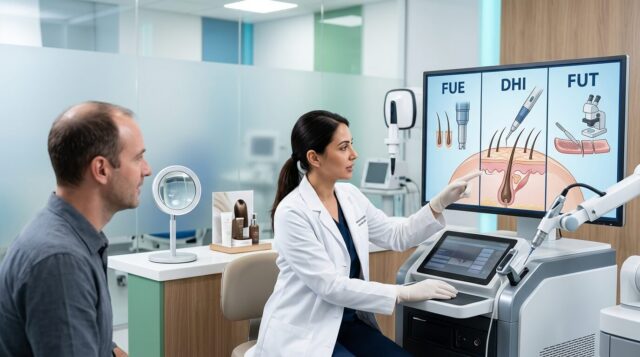
The fundamental distinction comes down to how grafts are extracted and how they’re implanted. FUT removes a strip of scalp from the donor area, while FUE and DHI extract individual follicular units. The implantation phase is where FUE vs DHI diverge: FUE requires the surgeon to create recipient channels first and then place grafts into them, while DHI combines both steps using a specialized pen-like tool called a Choi implanter.
The Evolution of FUE and FUT Procedures
FUT, or Follicular Unit Transplantation, was the gold standard from the late 1990s through the early 2010s. The surgeon removes a horizontal strip of tissue, typically 1-1.5 cm wide and 15-25 cm long, from the back of the scalp. A team of technicians then dissects that strip under stereoscopic microscopes into individual follicular units containing 1-4 hairs each. The wound is closed with sutures or staples, leaving a linear scar.
FUE, or Follicular Unit Extraction, replaced FUT as the most popular method by the mid-2010s. Instead of removing a strip, the surgeon uses a micro-punch tool, typically 0.7-1.0 mm in diameter, to extract individual follicular units directly from the donor zone. Each extraction creates a tiny circular wound that heals without a visible linear scar. The grafts are stored in a chilled holding solution, usually hypothermosol or saline, before being implanted into pre-made channels in the recipient area.
By 2026, FUE has undergone significant refinement. Motorized and robotic punch systems have increased extraction speed, reducing the time grafts spend outside the body. That matters because graft survival rates drop measurably after 4-6 hours of ex-vivo time. Faster extraction means higher viability, which translates to better density outcomes.
FUT hasn’t disappeared, though its market share has shrunk considerably. It still offers one distinct advantage: yield. A skilled FUT surgeon can harvest more grafts in a single session than most FUE procedures, sometimes exceeding 4,000-5,000 grafts. For patients with advanced hair loss (Norwood 5-7), that volume advantage can be meaningful. The trade-off is the linear scar, which limits short hairstyle options and requires a longer recovery period of 10-14 days compared to FUE’s typical 7-10 days.
DHI: The Premium Direct Implantation Method
DHI, or Direct Hair Implantation, uses the same extraction method as FUE but changes the implantation process entirely. Instead of creating recipient channels with a blade or needle and then placing grafts into them as a separate step, the DHI surgeon loads each graft into a Choi implanter pen and inserts it directly into the scalp. The pen simultaneously creates the channel and places the graft in a single motion.
This approach offers several clinical advantages. The surgeon controls the angle, depth, and direction of each graft with precision, typically placing hairs at 40-45 degree angles to mimic natural growth patterns. Because grafts spend less time outside the body, DHI can achieve slightly higher survival rates in experienced hands, often cited at 90-95% compared to FUE’s 85-92%.
The catch is speed and cost. DHI requires more Choi pens per session, often 6-8 pens that are either single-use or require sterilization between patients. Each graft takes longer to place individually, which extends surgical time by 2-3 hours for a typical 3,000-graft session. That extended time means higher labor costs, and the specialized training required for DHI surgeons is more intensive. DHI procedures are typically 30-40% more expensive than FUE because of these factors: longer procedure times, specialized tools, and higher technical skill requirements.
FUE vs DHI vs FUT Cost Analysis
Price is where most patients start their research, and it’s where the most confusion exists. A single number rarely tells the full story. Costs vary by country, clinic reputation, surgeon experience, graft count, and whether the procedure includes ancillary treatments like PRP (Platelet-Rich Plasma) therapy.
Price Per Graft and Total Procedure Estimates
The most standardized way to compare hair transplant costs is the per-graft price. Here’s what the 2026 market looks like across major regions:
| Technique | USA (per graft) | UK (per graft) | Turkey (per graft) | India (per graft) |
|---|---|---|---|---|
| FUT | $3.00 – $5.00 | £2.50 – £4.00 | $0.80 – $1.50 | $0.40 – $0.80 |
| FUE | $4.00 – $8.00 | £3.00 – £6.00 | $1.00 – $2.50 | $0.50 – $1.20 |
| DHI | $6.00 – $12.00 | £5.00 – £9.00 | $1.50 – $3.50 | $0.80 – $1.80 |
For a typical 2,500-graft procedure, this translates to:
- FUT in the US: $7,500 – $12,500
- FUE in the US: $10,000 – $20,000
- DHI in the US: $15,000 – $30,000
- FUE in Turkey: $2,500 – $6,250
- DHI in Turkey: $3,750 – $8,750
US clinics typically charge $4-$6 per graft for standard FUE procedures, though premium practices in cities like Los Angeles and New York can push well above $8 per graft. The variation within a single country can be as large as the variation between countries.
FUT consistently comes in as the least expensive option per graft because the extraction phase is faster and requires fewer specialized instruments. The strip technique allows a team of technicians to dissect grafts simultaneously while the surgeon closes the donor wound, creating an efficient division of labor. That efficiency translates directly to lower pricing.
Global Market Trends Affecting 2026 Pricing
Turkey remains the dominant force in hair transplant medical tourism, and its pricing continues to reshape patient expectations worldwide. The country performs an estimated 500,000-700,000 hair transplant procedures annually, with the majority concentrated in Istanbul’s Şişli and Fatih districts, both within 30 minutes of Istanbul Airport. Turkey’s hair transplant industry has driven prices as low as $1,500 to $6,000 per procedure, representing savings of up to 85-90% compared to the US or UK.
Several trends are shaping 2026 pricing globally:
- Increased competition in Turkey has driven down prices for basic FUE packages, but premium clinics offering surgeon-led procedures (rather than technician-performed ones) are holding or raising their rates.
- South Korea and Thailand have emerged as secondary medical tourism hubs, with pricing that falls between Turkey and Western markets.
- Insurance coverage remains essentially nonexistent for cosmetic hair transplants in all major markets, keeping the entire cost burden on patients.
- Package pricing has become the norm in Turkey and India, where clinics bundle hotel stays, airport transfers, PRP sessions, and post-operative medications into a single fee. A typical all-inclusive FUE package at a reputable Istanbul clinic like Estenove runs $2,500-$5,000 for up to 4,500 grafts.
The 22% annual market growth rate means more clinics are entering the space every quarter. That competition benefits patients on price but creates a critical vetting challenge: not all clinics offering low prices deliver equivalent surgical quality.
Evaluating Value: Success Rates vs Investment
Raw price comparisons miss the most important variable: what you actually get for your money. A $2,000 hair transplant that yields 60% graft survival is objectively worse value than a $5,000 procedure with 92% survival. The cost-per-surviving-graft calculation flips many assumptions.
Graft survival rates by technique, when performed by experienced surgeons, generally fall within these ranges:
- FUT: 90-95% (grafts are handled minimally during strip dissection)
- FUE: 85-92% (dependent on extraction speed and storage protocols)
- DHI: 90-95% (reduced out-of-body time improves viability)
FUT’s high survival rate surprises many patients who assume the newer techniques are automatically superior. The strip method protects follicles during extraction because they’re dissected under magnification rather than punched out blindly. The trade-off is the scar and recovery time, but in pure graft viability terms, FUT remains competitive.
DHI’s survival advantage over standard FUE narrows significantly when the FUE surgeon uses advanced graft storage solutions like hypothermosol and keeps total procedure time under 6 hours. The technique matters less than the surgeon’s speed, precision, and graft handling protocols.
Long-term Maintenance and Hidden Costs
The sticker price of your transplant is not the total cost of hair restoration. Several recurring and one-time expenses add up over the years following surgery.
Post-operative medications are the most significant ongoing cost. Most surgeons prescribe finasteride (approximately $30-$60/month) and minoxidil ($15-$40/month) to protect existing native hair from further miniaturization. Without these medications, patients often experience continued thinning around the transplanted area, creating an unnatural “island” effect that may require a second procedure.
PRP therapy, where concentrated platelets from your own blood are injected into the scalp to stimulate healing and growth, is increasingly recommended as a post-transplant supplement. Sessions cost $400-$1,200 each in the US, with most protocols calling for 3-4 sessions in the first year and annual maintenance sessions afterward.
A second transplant session is common for patients with progressive hair loss. Roughly 30-40% of transplant patients return for a second procedure within 5-10 years, either to increase density or address new areas of thinning. When calculating total investment, budgeting for a potential second session is realistic financial planning.
Hidden costs specific to medical tourism include:
- Travel and accommodation beyond what’s included in packages (companion travel, extended stays for complications)
- Follow-up consultations via telemedicine, which some clinics charge for after the initial post-operative period
- Revision procedures if graft survival falls below expectations, which may require travel back to the original clinic or paying a local surgeon at full domestic rates
The total 5-year cost of ownership for a hair transplant, including medications, PRP, and potential touch-ups, typically runs 40-60% higher than the initial procedure cost alone.
Choosing the Best Hair Transplant Technique for Your Budget
The best hair transplant technique in 2026 depends on three intersecting factors: your degree of hair loss, your budget ceiling, and your tolerance for scarring and recovery time. No single method is universally superior.
For patients with Norwood 2-3 hair loss (receding hairline with moderate thinning) who want minimal scarring and can afford the premium, DHI delivers the most precise hairline work. The Choi implanter allows the surgeon to control graft angle and spacing with millimeter-level accuracy, which matters most in the highly visible frontal zone. Expect to pay 30-40% more than FUE for this precision.
For patients with Norwood 4-6 hair loss requiring 3,000+ grafts, FUE offers the best balance of cost, scarring profile, and results. The technique handles large sessions well, and the per-graft cost savings over DHI become substantial at higher graft counts. A 4,000-graft DHI procedure in the US could cost $32,000-$48,000, while the same graft count via FUE might run $16,000-$32,000.
FUT makes financial sense in two specific scenarios: patients who need maximum graft yield in a single session and don’t mind wearing their hair at least 2-3 cm long to cover the linear scar, and patients on tight budgets who prioritize graft count over cosmetic recovery. FUT’s lower per-graft cost means you can get 20-30% more grafts for the same money compared to FUE.
A practical decision framework:
- Budget under $5,000: Consider FUE or FUT in Turkey or India at an accredited clinic. Ask specifically whether the surgeon performs the extraction and implantation personally or delegates to technicians.
- Budget $5,000-$15,000: FUE at a premium international clinic or DHI for smaller sessions (under 2,500 grafts). This range opens up the best clinics in Turkey and competitive options in South Korea.
- Budget $15,000+: DHI or FUE with a top-tier surgeon in your home country. At this price point, you’re paying for surgeon reputation, personalized protocols, and convenient follow-up care.
Whichever technique you choose, verify three things before committing: the surgeon’s personal case portfolio (not the clinic’s general gallery), the graft survival guarantee or policy, and the post-operative support protocol including medication guidance and follow-up scheduling.
Track your results objectively by taking monthly photos of your hairline and crown under consistent lighting, starting from day one. Visible growth typically begins at months 4-5, with final density assessable at 12-18 months. If you’re at month 10 and seeing sparse results, that’s the time to contact your surgeon about next steps, not month 18.
FAQ
Both FUE and DHI extract individual follicular units using micro-punch tools, typically 0.7-1.0 mm in diameter. The difference is in implantation. FUE requires the surgeon to first create recipient channels using a sapphire blade or steel needle, then place grafts into those channels as a separate step. DHI uses a Choi implanter pen that creates the channel and places the graft simultaneously. DHI gives the surgeon more control over implantation angle and depth but takes longer and costs more. For most patients, the visible results are comparable when both procedures are performed by equally skilled surgeons.
There is no single best technique: the right choice depends on your hair loss pattern, budget, and priorities. DHI excels for hairline refinement and smaller sessions where precision matters most. FUE is the most versatile option, handling everything from 1,000-graft touch-ups to 5,000-graft mega-sessions. FUT still holds value for patients needing maximum grafts per session at the lowest per-graft cost. The surgeon’s skill and experience with their chosen technique matters more than the technique itself. A great FUE surgeon will outperform an average DHI surgeon every time.
Yes, though its market share has declined to an estimated 15-20% of all hair transplant procedures globally. FUT remains the preferred method for certain surgeons who value its higher graft yield per session and excellent follicle preservation during dissection. It’s particularly common in the US and UK, where some of the most experienced transplant surgeons trained primarily in strip surgery. The linear scar remains the primary drawback, but modern trichophytic closure techniques have reduced scar visibility significantly compared to older methods. Patients who wear their hair at medium length or longer rarely have visible scarring.
DHI can achieve marginally higher density in the recipient area because the Choi implanter allows grafts to be placed closer together without damaging adjacent follicles. Skilled DHI surgeons report placing 60-80 grafts per square centimeter in the frontal zone, compared to 50-60 grafts per square centimeter with standard FUE channel creation. That said, the density difference is subtle and most noticeable in the first 1-2 cm of the hairline. For the mid-scalp and crown, where density requirements are lower, the difference between DHI and FUE becomes negligible. The 30-40% price premium for DHI is justified primarily for patients who want the densest possible hairline reconstruction.