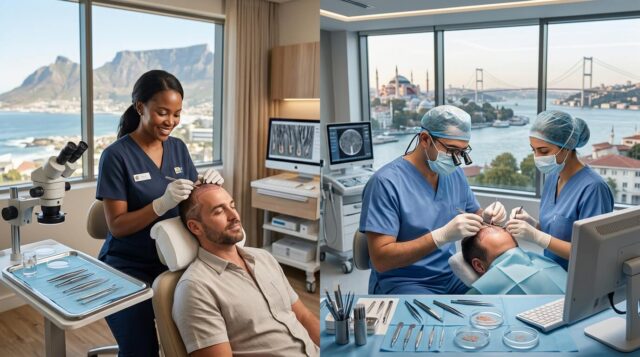

Choosing between a hair transplant in South Africa or Turkey is a decision thousands of patients face every year. Both destinations offer qualified surgeons and modern facilities, but the similarities start to thin out quickly once you compare pricing structures, clinical volume, patient logistics, and long-term outcomes. South Africa provides the comfort of a local procedure with no passport required, while Turkey has built an entire medical tourism ecosystem around hair restoration, complete with airport pickups, hotel stays, and dedicated aftercare teams.
The right choice depends on your budget, your comfort with international travel, and how many grafts you actually need. This comparison breaks down the real numbers, the clinical realities, and the practical experience of flying to Istanbul versus booking a local clinic in Johannesburg or Cape Town. If you have been weighing these two options, the details below should make your decision considerably easier.
Neither destination is universally “better” – but one will almost certainly be a better fit for your specific situation, timeline, and wallet.
Comparing Hair Transplant Cost in South Africa vs Turkey
Price is usually the first factor patients investigate, and for good reason. The gap between these two destinations can be significant, though it is not always as straightforward as it appears at first glance. Understanding exactly what you are paying for – and what you are not – matters more than the headline number on a quote.
All-Inclusive Packages vs Local Procedure Fees
Turkish clinics have standardized the all-inclusive package model. A typical offering covers the procedure itself, pre-operative blood tests, medications, a three- to four-night hotel stay, private airport transfers, and a translator. These packages can range from $2,000 to $5,000 depending on the technique (FUE, DHI, or sapphire FUE) and the clinic’s reputation. That price covers nearly everything except your flight.
South African clinics operate differently. Hair transplant costs in the country typically range between R30,000 and R85,000, which translates to roughly $1,600 to $4,500 USD. That figure generally covers the surgery and basic follow-up consultations, but accommodation, travel within the country, and extended aftercare are your responsibility. For patients in Johannesburg or Cape Town, this is less of an issue. For those in smaller cities, domestic travel adds up.
The bottom line: Turkish packages often appear cheaper because they bundle everything. South African quotes look comparable on paper, but out-of-pocket extras can push the real cost higher.
Value for Money: Graft Count and Hidden Expenses
Graft count is where the pricing conversation gets interesting. Many Turkish clinics offer a flat rate for up to 4,000 or even 5,000 grafts, regardless of how many you actually need. South African clinics typically charge per graft, with rates ranging from R8 to R25 per graft depending on the surgeon and technique.
For patients needing 2,000 grafts or fewer, South Africa can be competitive. But for Norwood 4-6 cases requiring 3,500+ grafts, the per-graft model in South Africa pushes costs toward the upper end of R85,000 or beyond. Turkey’s flat-rate model becomes dramatically more cost-effective at higher graft counts.
Hidden expenses to watch for in either destination include:
- PRP sessions: Often sold as add-ons in both countries, ranging from $200 to $600 per session
- Medication costs: Finasteride and minoxidil prescriptions post-op, typically $30 to $80/month
- Revision procedures: If growth is suboptimal, a second session may be necessary
- Travel insurance: Essential for Turkey-bound patients, often overlooked
Quality of Care and Medical Standards in Each Destination
Cost means nothing if the results are poor. Both Turkey and South Africa have excellent individual clinics, but the overall clinical environment differs in important ways.
Turkey’s Global Reputation as a Specialized Hub
Turkey attracts over 1.4 million international patients annually for medical procedures, with hair transplants representing one of the largest categories. Istanbul alone houses hundreds of hair restoration clinics, many concentrated in the Şişli and Mecidiyeköy districts within a short drive of Istanbul Airport.
This concentration has created genuine specialization. Surgeons at top-tier Turkish clinics perform 300 to 500 procedures per year, building a level of pattern recognition and technical refinement that is difficult to replicate in lower-volume settings. Clinics like Estenove offer FUE, DHI, and stem cell-assisted techniques with dedicated surgical teams who focus exclusively on hair restoration.
However, volume cuts both ways. The sheer number of clinics means quality varies enormously. Some facilities rely on unlicensed technicians to perform the actual extraction and implantation, with the named surgeon only present for consultations – a practice known as “ghost surgery.” Patients should ask directly: will the surgeon personally perform the extraction and implantation, or will technicians handle portions of the procedure? As one clinical review noted, many clinics are not as careful, potentially leading to poor growth, scarring, or unnatural hairlines. Vetting is essential.
South African Clinics: Regulatory Compliance and Local Safety
South Africa’s medical infrastructure is well-regulated by the Health Professions Council of South Africa (HPCSA), which oversees practitioner licensing and facility standards. The country has a smaller pool of hair transplant surgeons, but those who practice tend to have formal plastic surgery or dermatology backgrounds.
The advantage here is accountability. If something goes wrong, you have local legal recourse, follow-up appointments with the same surgeon, and no international travel required for corrections. Clinics in Sandton, Constantia, and Umhlanga operate in established medical parks with full hospital backup if complications arise.
The downside is limited specialization. Most South African surgeons perform hair transplants alongside other cosmetic procedures, meaning their annual case volume is lower. A surgeon performing 50 to 80 hair transplants per year will be competent, but may lack the nuanced expertise of someone doing five procedures per week.
Logistics and Patient Experience: Turkey vs South Africa Hair Clinic
The practical experience of getting a hair transplant in Turkey versus South Africa differs significantly, and these logistical details often tip the decision for patients who are on the fence.
Travel Requirements and Post-Operative Recovery Support
South Africans do not need a visa to enter Turkey for stays under 90 days, which removes a major barrier. Direct flights from Johannesburg to Istanbul run approximately 10 to 11 hours, with several airlines offering daily service. Most Turkish clinics coordinate the entire trip: a driver meets you at the airport, takes you to your hotel (usually in Şişli or Taksim), and shuttles you to the clinic the next morning.
The standard timeline for a Turkish hair transplant trip looks like this:
- Day 1: Arrival, hotel check-in, pre-operative consultation and blood work
- Day 2: Procedure day (6 to 10 hours depending on graft count)
- Day 3: First wash and aftercare instructions at the clinic
- Day 4: Second check-up, then departure
Post-operative recovery support is where Turkish clinics particularly shine. Most provide a dedicated WhatsApp line to a medical coordinator, video consultations at the one-month and three-month marks, and detailed photo-tracking protocols. Patients are typically advised to take monthly photos of the hairline and crown area under consistent lighting to monitor regrowth progress.
South African patients enjoy the obvious advantage of sleeping in their own bed the night after surgery. Follow-up visits happen in person with the same surgeon, and there is no jet lag to compound the initial discomfort. For patients with demanding work schedules or young children, this convenience is hard to overstate.
Recovery timelines are identical regardless of location: expect shedding of transplanted hairs between weeks two and four, early regrowth visible by month three or four, and final results at 12 to 18 months. During the shedding phase, keratin-based hair fibers and strategic parting adjustments can help camouflage the transitional appearance.
Determining the Best Country for Your Hair Transplant Needs
The decision between South Africa and Turkey ultimately comes down to three variables: graft count, budget, and risk tolerance.
If you need fewer than 2,000 grafts and live near a major South African city with a reputable surgeon, staying local makes strong practical sense. The cost difference at lower graft counts is minimal, and the convenience of local follow-up care is a genuine clinical advantage.
If you need 3,000+ grafts, Turkey’s flat-rate pricing model and high-volume surgical teams become hard to ignore. The savings can be substantial, sometimes R20,000 to R40,000 less than the equivalent procedure in South Africa, even after factoring in flights and incidentals.
For either destination, thorough vetting is non-negotiable. Request before-and-after galleries from patients with similar hair loss patterns to yours. Ask about the surgeon’s annual case volume. Confirm who physically performs each stage of the procedure. And get the full cost breakdown in writing before committing.
The comparison between a hair transplant in South Africa versus Turkey is not about one country being objectively superior. It is about matching your clinical needs, financial situation, and personal comfort level to the destination that serves you best. Do the homework, ask hard questions, and choose with confidence.
F.A.Q
For high graft counts (3,000+), Turkey is typically cheaper, even including flights. All-inclusive Turkish packages start around $2,000 and cap at $5,000 for complex cases. South African per-graft pricing can exceed R85,000 for similar procedures. At lower graft counts, the price difference narrows considerably.
Yes, Turkey is generally safe for South African medical tourists. No visa is required for stays under 90 days, and Istanbul’s medical tourism infrastructure is well-established. The primary risk is choosing an unvetted clinic. Stick to facilities with verifiable surgeon credentials, published patient results, and transparent pricing.
Costs range from R30,000 to R85,000 depending on the technique, surgeon, and number of grafts. FUE procedures tend to cost more per graft than FUT (strip method). PRP add-ons and post-operative medications are usually billed separately.
Neither country has a blanket quality advantage. The best Turkish clinics offer world-class results backed by extraordinary surgical volume. The best South African clinics offer strong regulatory oversight and convenient follow-up care. Quality depends entirely on the individual clinic and surgeon you choose, not the country itself.