
Every year, roughly 1.2 million international patients travel to Turkey for medical procedures, and hair restoration accounts for a significant share of that number. According to the Turkish Healthcare Travel Council’s 2025 report, hair transplant tourism alone generated over $1.5 billion in revenue, with Istanbul serving as the global epicenter. Yet the single most common question prospective patients ask before booking a flight has nothing to do with technique or price: it’s whether they should choose a specialized clinic or a full-service hospital. The distinction matters more than most people realize, affecting everything from who actually holds the scalpel to what happens if something goes wrong on the operating table. Understanding the real differences between a hair transplant clinic and a hospital in Turkey is the first step toward a decision you won’t regret.
Turkey’s medical tourism infrastructure is concentrated in a handful of Istanbul neighborhoods: Şişli, Mecidiyeköy, Levent, and the Fatih district near the historic peninsula. These areas house both private hospitals accredited by Joint Commission International (JCI) and boutique clinics that focus exclusively on hair restoration. The proximity to Istanbul Airport (IST) and Sabiha Gökçen Airport (SAW) makes logistics straightforward, but the choice between facility types requires a deeper look at credentials, protocols, and outcomes.
Understanding the Best Place for Hair Transplant in Turkey: Clinic vs. Hospital
The debate over whether a dedicated clinic or a hospital is the best place for a hair transplant in Turkey isn’t settled by a simple answer. Both settings produce excellent results under the right conditions, and both carry risks when standards slip. What separates them is structural: how each facility allocates resources, trains staff, and designs the patient journey from consultation to twelve-month follow-up.
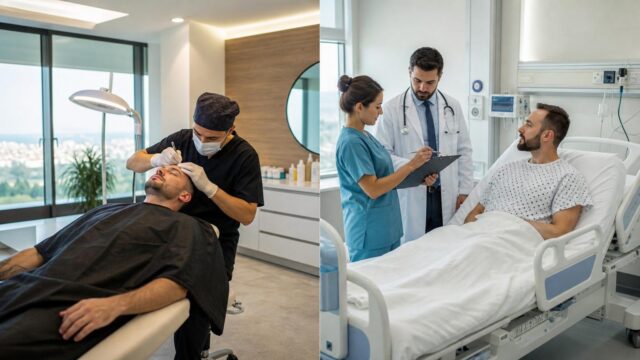
Turkey’s Ministry of Health regulates both hospitals and clinics under the same overarching framework, but the operational realities diverge sharply. A hospital is a multi-department institution offering services across dozens of specialties, from cardiology to orthopedics, with hair transplantation typically housed within a plastic surgery or dermatology department. A clinic, by contrast, is a single-purpose or limited-purpose facility. In the hair restoration context, a clinic may perform nothing but FUE, DHI, and stem cell-assisted transplants, day after day, with every square meter of the building designed for that workflow.
This structural difference creates trade-offs. Hospitals offer broader emergency infrastructure: ICU access, anesthesiologists on call, blood banks, and cross-specialty consultation. Clinics offer depth over breadth: highly repetitive procedural volume in one discipline, which tends to sharpen technique and reduce variability. A 2024 study published in the Journal of Cosmetic Dermatology found that facilities performing more than 500 hair transplant procedures per year reported 18% fewer graft survival complications than those performing fewer than 200. Volume matters, and clinics often accumulate it faster because hair restoration is their only business.
The financial model also differs. Hospital hair transplant departments typically carry higher overhead costs: shared administrative staff, facility maintenance across multiple floors, and compliance with broader accreditation standards that cover services unrelated to hair. Clinics can run leaner, which sometimes translates to lower patient pricing or higher investment per procedure in specialized tools like sapphire-tipped blades (1.0mm to 1.3mm diameter) and Choi implanter pens with 0.6mm to 0.8mm needles.
Neither model is inherently superior. The right choice depends on your medical history, the complexity of your case, and how you weigh specific factors like surgeon access, emergency preparedness, and post-operative care structure.
The Specialized Focus of Boutique Hair Clinics
Boutique hair clinics in Istanbul have built their reputations on doing one thing extraordinarily well. Facilities like Estenove, located in Istanbul’s medical corridor, represent this model: purpose-built environments where every protocol, piece of equipment, and staff member exists to serve hair restoration outcomes.
The typical boutique clinic employs a core team of two to four surgeons supported by six to twelve trained technicians. Because the clinic performs the same category of procedure daily, the team develops a rhythm that reduces operating time and improves graft handling. Graft out-of-body time is one of the most critical variables in transplant success. According to Dr. John Cole, a recognized authority in follicular unit extraction, grafts kept outside the body for more than 90 minutes without proper storage solution show measurably lower survival rates. Clinics that run tight, repetitive workflows routinely keep this window under 60 minutes.
The physical layout of a boutique clinic reflects its singular focus. Operating rooms are configured specifically for hair transplant ergonomics: adjustable patient chairs that allow prone and supine positioning, overhead LED surgical lights calibrated for scalp work (color temperature around 4,000K to 5,000K for accurate tissue visualization), and dedicated graft preparation stations equipped with stereoscopic microscopes at 10x to 25x magnification. Hospitals performing hair transplants often share operating theaters with other departments, which can mean less specialized setups.
Consultation depth tends to be higher in clinics as well. A dedicated hair restoration clinic typically offers 45- to 60-minute initial consultations, during which the surgeon personally evaluates donor density using a densitometer (measuring follicular units per square centimeter), assesses scalp laxity, and discusses realistic graft counts. Hospital departments, managing patient flow across multiple specialties, sometimes compress this to 15 or 20 minutes with a general practitioner conducting the initial screening.
The downside of boutique clinics is their limited scope. If you have underlying conditions like uncontrolled diabetes, cardiac arrhythmias, or bleeding disorders, a clinic may not have the on-site resources to manage complications that fall outside the hair transplant domain. Patients with complex medical histories should weigh this carefully.
The Multidisciplinary Environment of Hospital Hair Transplant in Istanbul
Hospitals offering hair transplants in Istanbul occupy a different niche. Institutions holding JCI accreditation or Turkish Ministry of Health “A-class” designation maintain infrastructure that no standalone clinic can match in terms of breadth.
The defining advantage of a hospital setting is cross-specialty access. If a patient experiences an adverse reaction to local anesthesia (lidocaine with epinephrine, typically administered at concentrations of 1% to 2%), a hospital can mobilize an anesthesiology team, administer IV medications, and transfer the patient to a monitored bed within minutes. Anaphylaxis during hair transplant procedures is rare, occurring in roughly 1 in 10,000 cases according to a 2023 meta-analysis in Aesthetic Surgery Journal, but when it happens, response time is everything.
Istanbul’s major private hospitals with active hair transplant departments are clustered in Şişli and Levent, within a 20-minute drive of most tourist-friendly hotels in Taksim and Beyoğlu. These hospitals typically house their hair restoration units within plastic surgery or dermatology departments, staffed by board-certified specialists who also perform reconstructive procedures, scar revision, and burn treatment. This broader surgical experience can be valuable for complex cases: patients with extensive scarring from previous procedures, those needing combined scalp reconstruction, or individuals requiring body hair transplant (BHT) from the chest or beard as supplementary donor sources.
Hospital laboratories also enable pre-operative blood work on-site, with results available within hours. A standard pre-transplant panel includes complete blood count (CBC), coagulation profile (PT/INR), hepatitis B and C screening, and HIV testing. Clinics typically outsource this to partner labs, which can add a day to the pre-operative timeline.
The trade-off is that hospitals often treat hair transplantation as one service line among many rather than the institution’s primary identity. Surgeon availability can be less predictable, and the patient may interact with rotating residents or junior doctors during parts of the process. The personalized, single-surgeon continuity that boutique clinics provide is harder to guarantee in a hospital setting.
Safety Protocols and Medical Standards in Turkish Facilities
Turkey’s regulatory framework for medical facilities underwent significant tightening between 2022 and 2025. The Ministry of Health introduced updated guidelines specifically targeting hair transplant operations, including mandatory surgeon presence requirements and facility inspection schedules. These regulations apply equally to clinics and hospitals, but implementation looks different in each setting.
All facilities performing hair transplants must hold a valid “Sağlık Kuruluşu” (healthcare establishment) license, renewed annually following on-site inspection. The inspection covers sterilization protocols, staff credentials, equipment maintenance logs, and patient record-keeping. Facilities found non-compliant face fines starting at 50,000 Turkish lira and potential closure orders for repeat violations.
Sterilization standards in Turkish medical facilities follow the Spaulding classification system. Instruments that penetrate skin or contact sterile tissue, including FUE punch tools (0.7mm to 1.0mm diameter), Choi pens, and sapphire blades, must undergo high-level sterilization via autoclave at 134°C for a minimum of 18 minutes. Single-use items like microblades and hypodermic needles must be opened from sealed packaging in the patient’s presence. Reputable facilities in both categories adhere to these standards, but enforcement consistency varies.
A 2025 audit by the Istanbul Provincial Health Directorate found that 94% of JCI-accredited hospitals met or exceeded sterilization benchmarks, compared to 87% of standalone clinics. The gap narrows considerably when filtering for clinics that voluntarily pursue international accreditation (such as ISO 9001 or TEMOS certification), where compliance reached 96%. The lesson: accreditation status is a stronger predictor of safety than facility type alone.
Which is Safer: Emergency Readiness and Sterilization Benchmarks
The question of which is safer, a clinic or hospital in Turkey, requires separating two distinct risk categories: procedural risk and systemic risk.
Procedural risk refers to complications directly related to the hair transplant itself: infection, poor graft survival, folliculitis, scalp necrosis from over-harvesting, or unnatural hairline design. These risks are primarily determined by surgeon skill, technique selection, and graft handling protocols, not by whether the building has an ICU upstairs. On procedural risk, high-volume clinics with experienced surgeons perform at least as well as hospital departments, and often better due to their concentrated expertise.
Systemic risk refers to medical emergencies unrelated to the transplant technique: cardiac events, severe allergic reactions, uncontrolled bleeding in patients with undiagnosed coagulopathies. Here, hospitals hold a clear advantage. A hospital with a crash cart, defibrillator, and on-call intensivist can manage a cardiac arrest. A clinic with basic resuscitation equipment can stabilize a patient and call an ambulance, but the response gap could be 15 to 30 minutes depending on Istanbul traffic conditions.
For healthy patients aged 25 to 55 with no significant comorbidities, the systemic risk differential is minimal. The probability of a life-threatening emergency during a hair transplant in a healthy individual is extremely low. For patients over 60, those with cardiovascular disease, or individuals taking anticoagulants like warfarin or rivaroxaban, the hospital setting offers a meaningful safety margin.
Practical steps to verify safety regardless of facility type:
- Request the surgeon’s medical license number and verify it through the Turkish Medical Association’s online registry
- Ask to see the facility’s most recent Ministry of Health inspection certificate (dated within the last 12 months)
- Confirm that the facility has a written emergency protocol, including transfer agreements with nearby hospitals (for clinics)
- Verify that pre-operative blood work is mandatory, not optional
- Ask whether the surgeon personally performs the critical phases: recipient site creation and hairline design
- Check for the presence of pulse oximetry monitoring and blood pressure tracking during the procedure
These questions apply equally to clinics and hospitals. A facility that resists answering them, regardless of its size or prestige, should be removed from your shortlist.
Key Differences in Patient Experience and Surgical Outcomes
Beyond safety and accreditation, the day-to-day experience of undergoing a hair transplant differs substantially between clinics and hospitals. These differences affect comfort, communication, and ultimately satisfaction with results.
Clinics designed exclusively for hair restoration typically offer a more curated patient journey. From airport pickup to post-operative care packages, the experience is built around a single service. Wait times are shorter because the facility isn’t managing emergency admissions or scheduling conflicts with other departments. Most boutique clinics in Istanbul cap their daily procedures at two to four patients, ensuring each case receives dedicated surgical and nursing attention.
Hospitals, by contrast, operate on institutional schedules. Hair transplant patients may share pre-operative areas with patients awaiting unrelated procedures. Check-in processes involve more paperwork and administrative steps. The upside is that hospitals often have dedicated patient coordinators who handle insurance documentation, medical record transfers, and multi-language communication through established international patient departments.
Post-operative care models also diverge. Clinics frequently include a next-day wash session as part of the package, during which a technician demonstrates proper washing technique: gentle circular motions using pH-neutral shampoo, water temperature between 36°C and 38°C, no direct water pressure on the recipient area for the first 10 days. Hospitals may provide written instructions and a follow-up appointment but leave the first wash to the patient.
Long-term follow-up is where clinics often outperform. Because hair restoration is their core business, clinics have structured follow-up protocols: photo documentation at 1 month, 3 months, 6 months, and 12 months, with remote consultations via video call for international patients. Hospital departments, managing diverse patient populations, may offer less granular tracking. Patients should ask specifically about the follow-up schedule before committing to either facility type.
Expected results timelines remain consistent regardless of setting, assuming equivalent surgical quality:
- Days 1 to 7: scabbing and mild swelling in the recipient area
- Weeks 2 to 4: transplanted hairs shed (this is normal and expected)
- Months 3 to 4: new growth begins as fine, light-colored hairs
- Months 6 to 8: noticeable density improvement; hairs thicken and darken
- Months 10 to 14: final results visible, with full density assessment possible
Tracking your own progress is straightforward. Take monthly photographs of your hairline and crown under consistent lighting (natural daylight, same angle, same distance) to create a visual timeline. This practice helps you and your surgeon assess growth objectively rather than relying on memory.
Direct Surgeon Involvement vs. Technician-Led Procedures
This is the single most consequential variable in hair transplant outcomes, and it cuts across both facility types.
“Ghost surgery” is a well-documented problem in Turkey’s hair transplant industry. The term refers to procedures where a patient consults with a named surgeon but the actual operation is performed partly or entirely by unlicensed technicians. A 2024 investigation by the International Society of Hair Restoration Surgery (ISHRS) estimated that up to 40% of hair transplant procedures in Istanbul involved significant technician-led components without the patient’s informed consent.
The Turkish Ministry of Health’s 2023 regulation update explicitly requires a licensed physician to perform recipient site incisions and oversee the entire procedure. Graft extraction and placement can be performed by trained technicians under direct surgeon supervision, but the surgeon must be physically present in the operating room. Compliance with this regulation varies.
In hospital settings, the presence of departmental oversight and institutional accountability provides some protection against ghost surgery. Hospitals maintain surgical logs reviewed by department heads, and staff credentialing is managed centrally. A technician performing unauthorized surgical acts in a hospital risks not just their own career but the institution’s accreditation.
In clinics, the risk depends entirely on the individual operation’s integrity. Some clinics maintain impeccable standards with the lead surgeon present for every critical phase. Others exploit the clinic model’s relative autonomy to run “assembly line” operations where one surgeon nominally oversees five or six simultaneous procedures in adjacent rooms.
How to protect yourself:
- During your consultation, ask the surgeon directly: “Will you personally create the recipient sites and design the hairline, or will a technician do this?”
- Request a written surgical plan that specifies which phases the surgeon performs and which are delegated to technicians
- Ask how many procedures the surgeon oversees per day; more than two simultaneous cases is a red flag
- Look for video testimonials from previous patients that show the surgeon actively operating, not just posing for photos
- Check whether the surgeon is a member of ISHRS or the European Hair Research Society (EHRS), which hold members to ethical practice standards
The distinction between surgeon-led and technician-led procedures matters more than any other factor in determining your outcome. A skilled surgeon in a modest clinic will outperform a technician-led operation in a prestigious hospital every time. Prioritize the person holding the instrument over the name on the building.
For patients considering stem cell-assisted hair transplants, surgeon involvement becomes even more critical. The preparation and application of platelet-rich plasma (PRP) or stem cell solutions requires precise technique: centrifugation at 1,500 to 3,000 RPM for 5 to 10 minutes, followed by injection into the recipient area at depths of 1.5mm to 2.5mm using 30-gauge needles. This is a physician-level task that should never be delegated to unsupervised technicians.