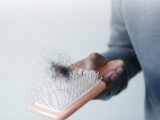


Dandruff does not cause permanent baldness. Flaking on its own leaves the hair follicle intact. What can push hair out early is the inflammation behind more severe dandruff and the repeated scratching it provokes — and that hair usually grows back once the scalp settles. Thinning that keeps progressing after the flakes clear normally has a separate cause.
The practical distinction matters. Treating dandruff protects hair from the collateral damage of itching and inflammation. It will not stop hereditary hair loss, and expecting it to is how people lose months of useful treatment time.
What dandruff actually is
Dandruff and seborrheic dermatitis sit on one continuous spectrum of the same condition. Dandruff is the mild end: flaking and itch confined to the scalp, without visible inflammation. Seborrheic dermatitis is the same process with visible redness, greasier yellowish scale, and a tendency to spread beyond the scalp — to the eyebrows, the creases beside the nose, behind the ears and onto the chest.
It is extremely common. A comprehensive review of the literature puts dandruff at roughly half the adult population worldwide, with meaningful variation between populations. It is not a hygiene problem, and it is not contagious.
Three conditions are usually confused with each other, and they need different handling:
| Dry scalp | Dandruff | Seborrheic dermatitis | |
| Flakes | Small, white, dry, scattered | Larger, white to grey, often oily | Greasy, yellowish, adherent scale |
| Scalp appearance | Tight, dry, no redness | Normal colour, may look oily | Visible redness and irritation |
| Itch | Mild | Mild to moderate | Moderate to severe |
| Elsewhere on body | Dry skin on arms, legs | Scalp only | Eyebrows, nose creases, ears, chest |
| Responds to | Moisture, gentler washing | Anti-dandruff actives | Antifungal and anti-inflammatory treatment |
Reaching for a moisturising shampoo when the problem is seborrheic dermatitis is one of the more common reasons people conclude that “nothing works”.
How dandruff forms
Three things have to line up: active sebaceous glands, a yeast called Malassezia that lives normally on almost everyone’s skin, and individual susceptibility.
Malassezia feeds on the lipids in sebum. It breaks down triglycerides and releases free fatty acids — oleic acid among them. Most people tolerate this without noticing. In susceptible people, those metabolites irritate the scalp: skin cells respond by producing inflammatory signals, the skin barrier is disrupted, and the normally invisible turnover of surface skin cells speeds up and becomes disordered. Instead of shedding as single microscopic cells, they come off in visible clumps. Those clumps are the flakes.
This explains two things people find confusing. Dandruff typically starts after puberty, because that is when sebum production rises. And it fluctuates with stress, cold weather and illness, because susceptibility is not constant.
Where “dandruff hair loss” actually comes from
Flaking does not damage the follicle. When people lose hair alongside dandruff, one of four things is usually happening — and they are not equally well supported by evidence.
Scratching and mechanical damage — the common one
This is the mechanism that accounts for most dandruff-associated hair damage, and it is mostly breakage rather than true hair loss. Repeated scratching, vigorous rubbing and aggressive combing to lift scale snap hairs partway along the shaft. Fingernails on a scalp that is already inflamed can also pull out growing hairs that had no business coming out yet.
You can usually tell the difference by looking at what comes away in your hand. A naturally shed hair has a small pale bulb at the root end. A broken hair does not — it has two blunt ends, and broken hairs come in noticeably varied lengths. Hair breakage is a recognised cause of hair thinning, and it is fully reversible once the cause stops, because the follicle was never involved.
Inflammation around the follicle
In seborrheic dermatitis — the inflamed end of the spectrum — the follicle sits in an actively inflamed environment. It is biologically plausible that sustained inflammation nudges follicles into their resting phase earlier than they would otherwise go, and this is a common clinical observation. It is worth being honest about the status of that evidence: it is a reasonable mechanism rather than a settled one. The comprehensive review literature on dandruff and seborrheic dermatitis does not establish either condition as a cause of generalised hair shedding.
Severe, crusted disease
At the severe end, where thick adherent crusting sits on the scalp, the literature does describe associated hair loss. This is uncommon, it looks obviously different from everyday flaking, and it needs prescription treatment rather than a supermarket shampoo.
Dandruff sitting on top of unrelated hair loss
This is the explanation most articles skip, and it accounts for a great deal of the perceived link. Dandruff affects around half of adults. Hereditary pattern hair loss is also extremely common, and both are influenced by sebum and androgens, so the same person frequently has both at the same time. Two common conditions overlapping is not the same as one causing the other.
The practical test is what happens to each one independently. Clearing the flakes should settle the itch and stop the breakage. If density keeps declining after the scalp is calm, something else is driving it.
Will hair lost alongside dandruff grow back?
In most cases yes, because the follicle was not destroyed — but the timeline depends on which mechanism was at work.
- Breakage. The follicle is untouched and still growing. Recovery is a matter of the hair growing back out, and scalp hair grows roughly a centimetre a month, so visible improvement in length and body takes several months rather than weeks.
- Early-shed hairs from inflammation. These regrow once the follicle re-enters its growth phase. For comparable temporary shedding, dermatology sources describe recovery over a period of months rather than weeks once the trigger is removed.
- Severe crusted disease. Regrowth generally follows successful treatment, but this needs medical management and individual assessment.
The exception is scarring, where the follicle is permanently replaced by scar tissue. That is not a feature of ordinary dandruff, and it is one of the reasons persistent, painful or pustular scalp disease should be looked at rather than self-treated indefinitely.
No article can promise regrowth for an individual. What can be said is that the mechanisms that link dandruff to hair change are, with rare exceptions, non-scarring.
Do dandruff shampoos cause hair loss?
There is no reliable evidence that standard anti-dandruff shampoos cause hair loss. Where it has been measured directly, the effect goes the other way.
A six-month trial in 150 men who had hair shedding alongside dandruff compared shampoos containing 1% ketoconazole, 1% piroctone olamine and 1% zinc pyrithione. All three reduced itch, flaking and hair shedding; shedding fell by around 17% in the ketoconazole group. Separately, a Cochrane systematic review of topical antifungals for seborrhoeic dermatitis found ketoconazole reduced persistent symptoms compared with placebo at four weeks and performed comparably to topical steroids with substantially fewer side effects — while noting that the underlying evidence was of low quality and the trials were short.
Read carefully, that supports a modest claim: a ketoconazole shampoo is an effective dandruff treatment, and controlling the dandruff appears to reduce the shedding that came with it. It does not make it a hair loss drug. A 2020 systematic review looking specifically at topical ketoconazole for androgenetic alopecia found only a handful of studies, two of them in animals, and concluded the evidence base was limited.
So why do so many people feel their dandruff shampoo made things worse? Usually one of three reasons:
- A change in wash frequency. Hairs that have already detached stay trapped in the surrounding hair until something releases them. Starting a new routine often means washing more often at first, and the first wash or two flushes out an accumulated backlog. It looks like a surge; it is a redistribution.
- Timing. People start medicated shampoo when the scalp is at its worst — which is also when itching, scratching and breakage are at their peak. The shampoo arrives in the middle of the problem and gets blamed for it.
- Dryness. Some formulations, particularly those built around salicylic acid or coal tar, are drying. On curly, coily, chemically treated or long hair, dry hair breaks more easily. That is a real effect, but the answer is conditioning the lengths and adjusting frequency, not stopping treatment.
Treating dandruff so the follicle is not collateral damage
The goal is to shut down the itch quickly, because the scratching is the part that damages hair.
| Active ingredient | What it does | Best suited to |
| Ketoconazole | Antifungal — reduces Malassezia | Persistent or recurring dandruff; seborrheic dermatitis |
| Zinc pyrithione | Antifungal and antibacterial | Routine mild to moderate dandruff |
| Selenium sulfide | Antifungal; slows skin cell turnover | Heavier flaking |
| Ciclopirox | Antifungal | Alternative when ketoconazole is unsuitable |
| Coal tar | Slows skin cell turnover | Thicker, scaly plaques; can be drying |
| Salicylic acid | Lifts existing scale | Scale removal — does not treat the underlying cause |
A few points that make more difference than the choice of bottle:
- Give it contact time. Follow the product directions rather than rinsing immediately — the active needs to reach the scalp, not the hair.
- Target the scalp. Work the product into the scalp itself. Lathering the lengths cleans hair without treating anything.
- Match frequency to hair type. The American Academy of Dermatology advises using dandruff shampoo two to three times a week for straight or wavy hair, but only about once a week for curly or tightly coiled hair, which is far more prone to dryness and breakage.
- Rotate actives if one stops working. The AAD suggests alternating between shampoos with different active ingredients rather than persisting with one that has lost its effect.
- Condition the lengths. Treat the scalp, then condition from mid-length down. This offsets the drying effect that causes breakage.
- Deal with the itch directly. Cool rather than hot water, and keeping nails short, reduces the damage done between washes.
- Set a four-week checkpoint. NHS guidance is to see a doctor if dandruff has not improved after at least four weeks of anti-dandruff shampoo. That is a concrete stopping point rather than an indefinite trial.
When to see a dermatologist
Book an appointment if any of the following apply:
- Four weeks of an appropriate anti-dandruff shampoo has not improved things.
- The scalp is red, swollen, sore, weeping or crusted.
- There are defined bald patches rather than general thinning.
- There is pain, burning, pus or a smell — none of these belong to ordinary dandruff.
- Flaky, itchy patches have appeared on the face, ears or body as well as the scalp.
- Hair density is still falling after the flaking has cleared.
- The scalp is scaly with broken-off hairs and black dots, particularly in a child — scalp ringworm is a fungal infection that needs oral treatment and can spread between people.
- Shedding started suddenly and heavily, which points towards a temporary shedding event rather than a scalp problem.
If hair loss continues after the scalp is calm
Once the flaking is controlled and the itch has gone, any remaining thinning is a separate question — and worth investigating on its own terms rather than as a dandruff sequel.
A dermatology assessment usually covers your history including the previous six months, a scalp examination often with dermoscopy, a gentle pull test to gauge active shedding, and in some cases blood tests such as ferritin and thyroid function. A scalp biopsy is occasionally used when the picture is unclear or scarring is suspected. The point is to name the pattern, because treatment diverges sharply from there.
Temporary shedding after illness, stress or childbirth usually resolves once the trigger passes and needs no drug treatment. Hereditary pattern hair loss is progressive without treatment, and the American Academy of Dermatology is explicit that the earlier treatment starts, the better it works — which is the strongest practical argument for getting a diagnosis rather than waiting to see.
Where pattern loss is well established, stable and non-scarring, and medical treatment alone will not restore density, surgical options come into the conversation. Anyone weighing hair transplant options should understand that it is a redistribution of existing follicles rather than new growth, that it depends on having a sufficient donor area, and that it is not appropriate for active inflammatory scalp disease, scarring conditions or temporary shedding. A reputable assessment will decline as often as it recommends.
For most people reading this, none of that applies. The scalp is itchy, the flakes are annoying, and some hair is coming away in the shower. The most useful thing to take from it is that the itch is not a cosmetic complaint — it is the part of dandruff that actually costs you hair, and it is the part that responds fastest to treatment.
External Sources & References
- American Academy of Dermatology. *Do you have hair loss or hair shedding?* https://www.aad.org/public/diseases/hair-loss/insider/shedding
- American Academy of Dermatology. *Hair loss: Who gets and causes.* https://www.aad.org/public/diseases/hair-loss/causes/18-causes
- American Academy of Dermatology. *How to treat dandruff.* https://www.aad.org/public/everyday-care/hair-scalp-care/scalp/treat-dandruff
- American Academy of Dermatology. *Seborrheic dermatitis: Signs and symptoms.* https://www.aad.org/public/diseases/a-z/seborrheic-dermatitis-symptoms
- NHS. *Dandruff.* https://www.nhs.uk/conditions/dandruff/