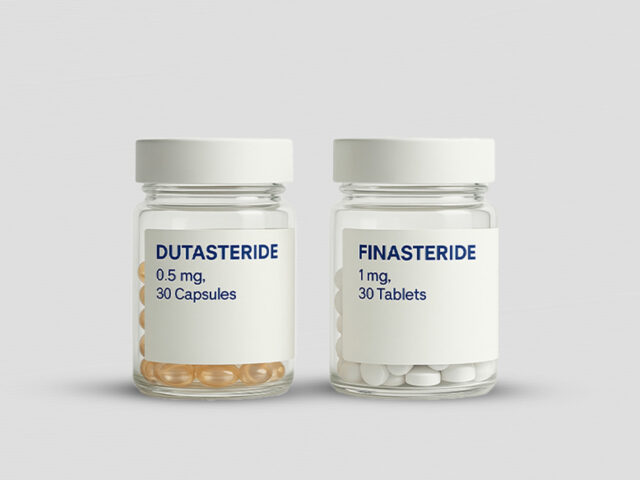

Dutasteride vs finasteride comes down to one difference: finasteride blocks the Type 2 enzyme and reduces DHT by around 71%, while dutasteride blocks both Type 1 and Type 2 and reduces DHT by up to 98%. Dutasteride produces greater regrowth in trials; finasteride is the only one of the two approved for hair loss.
Key Take Aways:
Mechanism: both drugs stop the body converting testosterone into DHT, the hormone that drives male pattern baldness.
Potency: finasteride reduces DHT by around 71%; dutasteride by up to 98%.
Approval: finasteride is FDA-approved for hair loss; dutasteride is approved for prostate enlargement and used off-label.
Dosing: finasteride 1 mg daily; dutasteride 0.5 mg daily.
Clearance: finasteride leaves the body within about a day; dutasteride takes several weeks.
Choosing between these two drugs is not just a technical decision about blocking hormones. It’s a balance of effectiveness, long‑term safety, personal risk tolerance, and how aggressive the hair loss already is. Understanding how each medication works and what recent research actually shows helps set realistic expectations and makes discussions with a dermatologist far more productive. This article is informational only and not a substitute for personalized medical advice.
How Dutasteride & Finasteride Work for Hair Loss: Understanding Mechanisms
Dutasteride and finasteride both target the same root problem in male pattern baldness: the conversion of testosterone into dihydrotestosterone (DHT). This conversion is driven by an enzyme called 5‑alpha reductase, which exists in different forms in the body. By blocking this enzyme, these drugs reduce DHT levels, which in turn reduces damage to hair follicles on the scalp.
The key pharmacological difference is that dutasteride inhibits both type 1 and type 2 5‑alpha reductase, while finasteride mainly targets the type 2 form, leading to a broader enzyme blockade with dutasteride according to a detailed analysis from Bernstein Medical. That broader inhibition is central to why dutasteride tends to produce stronger hair regrowth and stabilization in clinical trials.
The Role of DHT in Male Pattern Baldness
Male pattern hair loss is driven by genetic sensitivity of hair follicles to DHT. In susceptible men, DHT progressively miniaturizes hair follicles on the scalp, especially along the hairline and crown. Hairs become thinner, shorter, and lighter over time until they stop emerging altogether.
Because testosterone itself is important for normal male physiology, the goal is not to eliminate testosterone but to reduce the local and systemic burden of DHT. Studies have shown that dutasteride can suppress serum DHT levels by up to 98%, compared with about 71% for finasteride, according to a pharmacological review from MedX. That deeper DHT reduction is one of the main explanations for dutasteride’s superior performance in many patients.
Studies have shown that dutasteride can suppress serum DHT levels by up to 98%, compared with about 71% for finasteride.
How 5-Alpha Reductase Inhibitors Work
Both dutasteride and finasteride are taken orally and absorbed systemically, then circulate to tissues where 5‑alpha reductase is active. By binding to the enzyme and preventing it from converting testosterone to DHT, they lower DHT levels throughout the body, including in the scalp. Over time, this reduced DHT environment allows miniaturized follicles to recover some of their function and produce thicker, more pigmented hair shafts.
Dutasteride’s ability to inhibit both type 1 and type 2 5‑alpha reductase, as mentioned, means it acts on a wider range of tissues and enzyme sites than finasteride. This broader action contributes to more robust DHT suppression and, for many men, more visible improvement in hair density, especially in more advanced stages of androgenetic alopecia.
Comparing Dutasteride and Finasteride: Key Differences
From a practical standpoint, most people care about two things: how much hair can be preserved or regrown, and what the side effects look like. On both fronts, dutasteride and finasteride share similarities, but the evidence increasingly points to dutasteride as the more potent option for hair outcomes.
Finasteride still has a strong track record and is widely prescribed, in part because it has been on the market longer and is approved for male hair loss in many countries. Dutasteride, while officially approved for prostate enlargement in several regions, is used off‑label for hair loss based on growing clinical evidence and expert consensus supporting its effectiveness in androgenetic alopecia.
For many men, finasteride has been the default prescription for male pattern hair loss for years, yet a newer option dutasteride is quietly outperforming it in head‑to‑head data.
Dutasteride vs Finasteride: Side-by-Side Comparison
| Factor | Finasteride | Dutasteride |
|---|---|---|
| Brand names | Propecia (1 mg), Proscar (5 mg) | Avodart |
| Enzyme blocked | Type 2 5-alpha reductase | Type 1 and Type 2 5-alpha reductase |
| Serum DHT reduction | around 71% | up to 98% |
| Usual hair loss dose | 1 mg daily | 0.5 mg daily |
| Approval for hair loss | FDA-approved for male pattern hair loss | Approved for prostate enlargement; used off-label |
| Elimination from the body | Cleared within about a day |
Cleared over several weeks |
The finasteride and dutasteride difference comes down to how much of the 5-alpha reductase pathway each drug shuts down. Dutasteride is the more potent DHT blocker; finasteride is the one carrying a hair loss licence.
Avodart vs Propecia: The Brand Names Explained
Avodart vs Propecia is the same comparison under brand names. Propecia is finasteride at the 1 mg hair loss dose. Proscar is the same molecule at 5 mg, licensed for prostate enlargement rather than hair loss. Avodart is dutasteride, licensed at 0.5 mg for prostate enlargement and prescribed off-label for androgenetic alopecia.
Generic versions of both finasteride and dutasteride are widely available and contain the same active ingredient at the same dose as the branded product. Which one you are given is usually a matter of prescribing practice and cost rather than a clinical difference.
Which One Is More Effective: Potency and DHT Suppression Differences
Many patients naturally wonder, is dutasteride better than finasteride, especially when comparing real-world results and clinical evidence. For many men, finasteride has been the default prescription for male pattern hair loss for years, yet a newer option dutasteride is quietly outperforming it in head‑to‑head data.
Across the published comparisons dutasteride provides greater DHT suppression and larger measured increases in hair count than finasteride. That evidence sits alongside an important qualifier: dutasteride is not approved for hair loss and is prescribed off-label for this purpose, while finasteride holds the licence. In a dutasteride vs finasteride decision, greater measured efficacy in a trial setting is therefore only one part of the picture.
A randomized trial found that dutasteride 0.5 mg/day produced significantly greater increases in hair count than finasteride 1 mg/day over 24 weeks of treatment, according to data published in a controlled comparison on PubMed. That kind of head‑to‑head design offers direct evidence that the stronger DHT suppression seen with dutasteride translates into more noticeable hair benefits.
Comparisons of finasteride 5mg vs dutasteride 0.5 mg come up regularly, because 5 mg is the prostate dose of finasteride rather than the hair loss dose. Raising finasteride from 1 mg to 5 mg does not proportionally increase DHT suppression: the Type 2 enzyme is already close to fully blocked at 1 mg, which is why 1 mg is the licensed hair loss dose. Dutasteride achieves deeper suppression by blocking the Type 1 enzyme as well, not by being a larger dose of the same mechanism. Neither drug is prescribed at the other’s dose for hair loss without specialist input.
Beyond individual trials, broader analyses also favor dutasteride. Network and traditional meta-analyses consistently report better efficacy outcomes for dutasteride across measures like hair count and global photographic assessment, supporting the view that it is a more powerful choice when the primary goal is maximizing regrowth and halting progression as much as possible. A large network meta-analysis found that oral dutasteride 0.5 mg/day was more effective for androgenetic alopecia than finasteride 1 mg/day and even topical minoxidil 5%, putting it firmly in the spotlight for anyone serious about regrowing or preserving hair.
Side Effect Profiles and Safety Considerations
Any systemic hormone‑modifying medication raises fair questions about safety. Sexual side effects such as reduced libido, erectile difficulties, or decreased ejaculate volume are the most commonly discussed concerns with both drugs. A systematic review of 5‑alpha reductase inhibitors found that adverse events with dutasteride and finasteride were broadly similar in frequency and nature, suggesting a comparable safety profile between the two options when used for hair loss.
Mood‑related effects have also received increasing attention. The European Medicines Agency confirmed in May 2025 that suicidal thoughts are a side effect associated with finasteride and required updates to the product information, according to reporting by Reuters. That does not mean most users will experience these issues, but it underscores the importance of monitoring mood changes closely and stopping the drug promptly while seeking medical guidance if any concerning symptoms arise.
Making the Right Treatment Choice
Deciding between dutasteride and finasteride is rarely as simple as “stronger is better.” The choice depends on how fast the hair loss is progressing, how much regrowth is desired versus just stabilization, current health status, and how comfortable someone is with potential side effects and off‑label use.
Many men start with finasteride because of its long history and formal hair‑loss indication in some countries, then consider dutasteride if results are modest or if hair loss continues despite good adherence. Others with aggressive or advanced thinning may discuss starting directly with dutasteride to try to preserve as much hair as possible early on.
Efficacy Data and Clinical Studies
When looking strictly at published evidence, dutasteride holds a consistent edge. A meta-analysis focusing on male androgenetic alopecia concluded that dutasteride provides better efficacy than finasteride across key clinical endpoints, as summarized in a review indexed on PubMed. Combined with earlier trials and comparative pharmacology, this creates a strong case for dutasteride as the more potent drug for increasing hair counts and improving overall scalp coverage.
Still, averages from studies do not guarantee individual outcomes. Some people respond very well to finasteride and may see little added benefit from escalating to dutasteride, while others experience a clear jump in density after switching. Response tends to vary with genetics, pattern and stage of loss, and concurrent treatments such as topical minoxidil or low‑level laser therapy.
Personalized Approaches Based on Hair Loss Severity
A thoughtful hair‑loss plan starts with an accurate diagnosis from a dermatologist or hair‑restoration specialist. For mild recession or early thinning, especially in younger men, finasteride may provide an effective balance of benefit and long‑term comfort with the safety data. Regular follow‑up allows dose adjustments or medication changes if progression continues.
For more advanced hair loss, strong family history of aggressive balding, or inadequate response to finasteride, dutasteride can be a strategic next step. Its greater DHT suppression and superior performance in comparative studies make it a logical option for those wanting to be more aggressive against ongoing miniaturization. Whatever the choice, open communication about side effects, mental health, fertility plans, and long‑term expectations is essential, and no medication should be started or stopped without guidance from a qualified healthcare professional.
If Finasteride Doesn’t Work, Will Dutasteride Help?
If finasteride doesn’t work will dutasteride do better? Possibly, and it is the most common reason patients look at a dutasteride vs finasteride switch. Finasteride leaves roughly a quarter to a third of scalp DHT in circulation, and in some men that residual level is enough for miniaturisation to continue. Dutasteride suppresses DHT more completely, which is the rationale for changing.
Before concluding that finasteride has failed, two things are worth checking. Results take time: most clinicians assess response at 12 months rather than earlier, and early shedding in the first few months is not treatment failure. Dosing consistency matters too, since intermittent use is a frequent reason for a poor response.
If response is genuinely inadequate after a fair trial, switching to dutasteride is a recognised next step, but it is a prescription decision. Dutasteride is used off-label for hair loss, it clears from the body far more slowly than finasteride, and both the potential benefit and the side-effect profile should be discussed with a doctor before any change is made.
How Long Each Drug Stays in the Body
Finasteride is eliminated within about a day of the last dose. Dutasteride persists for several weeks.
That difference matters in two situations. If side effects develop, they typically settle more quickly after stopping finasteride than after stopping dutasteride. And when switching between the two, the slower clearance means dutasteride’s effect — both wanted and unwanted — does not stop the day you stop taking it. Blood donation restrictions apply to both drugs and run for longer with dutasteride; your prescriber will advise on the current guidance.
Medical Disclaimer: This guide to hair loss medication compares the efficacy and safety profiles of Dutasteride and Finasteride. These are prescription medications with potential hormonal side effects. The medical information on this site is provided as an information resource only. Medically reviewed by the Estenove Clinical Board.
Frequently Asked Questions (FAQ)
Can you take finasteride and dutasteride together?
They are generally not taken together. Both act on the same hormonal pathway, so combining them adds little additional DHT suppression while increasing exposure. Patients who want more than finasteride provides are usually switched to dutasteride rather than given both. Minoxidil works through a different mechanism and is commonly used alongside either drug.
Which is better finasteride or dutasteride?
On published evidence dutasteride produces greater DHT suppression and larger hair count increases. Finasteride is the only one licensed for hair loss, has the longer safety record in this indication, and clears the body far more quickly. The better choice depends on how much regrowth you need, how you tolerate treatment, and your prescriber’s assessment.
Is finasteride and dutasteride the same drug?
No. They are two different molecules. Finasteride blocks only the Type 2 5-alpha reductase enzyme; dutasteride blocks Type 1 and Type 2. They are not interchangeable and are not prescribed at each other’s doses.
Can dutasteride regrow lost hair?
Dutasteride can thicken miniaturised follicles that are still alive, and studies show measurable increases in hair count. It cannot regenerate follicles that have been lost entirely — once a follicle is gone, surgical restoration is the only way to replace it.
How risky is dutasteride?
Reported adverse events with dutasteride and finasteride are broadly similar in frequency and nature, with sexual side effects the most commonly discussed. Most users do not experience them. Dutasteride’s off-label status and slower clearance are both relevant to the risk discussion, which is why it should only be taken under medical supervision.
Does dutasteride have feminising effects?
No. Dutasteride reduces DHT, an androgen, but it does not introduce oestrogen or cause feminisation. Breast tenderness or enlargement is listed as an uncommon side effect of both drugs and should be reported to your doctor.