Every year, thousands of Irish and British men fly south or east for a hair transplant, and two destinations dominate the conversation: Spain and Turkey. The price gap between the two countries is real, but cost alone never tells the full story. Surgeon qualifications, clinic infrastructure, aftercare protocols, and even flight logistics shape the final outcome just as much as the quoted fee. With the global hair restoration market projected to reach $21.73 billion by 2032 at a 16.5% CAGR, demand is surging, and so is the number of clinics competing for your business. This guide breaks down exactly what you’re paying for in each country, where the quality benchmarks differ, and how to make a confident decision.
Comparing Hair Transplant Cost Spain vs Turkey
Price is the first filter most patients apply, and the numbers between these two destinations are strikingly different. Understanding what drives those figures helps you compare apples to apples rather than brochure quotes to brochure quotes.
All-Inclusive Packages in Turkey vs. Pay-per-Graft in Spain
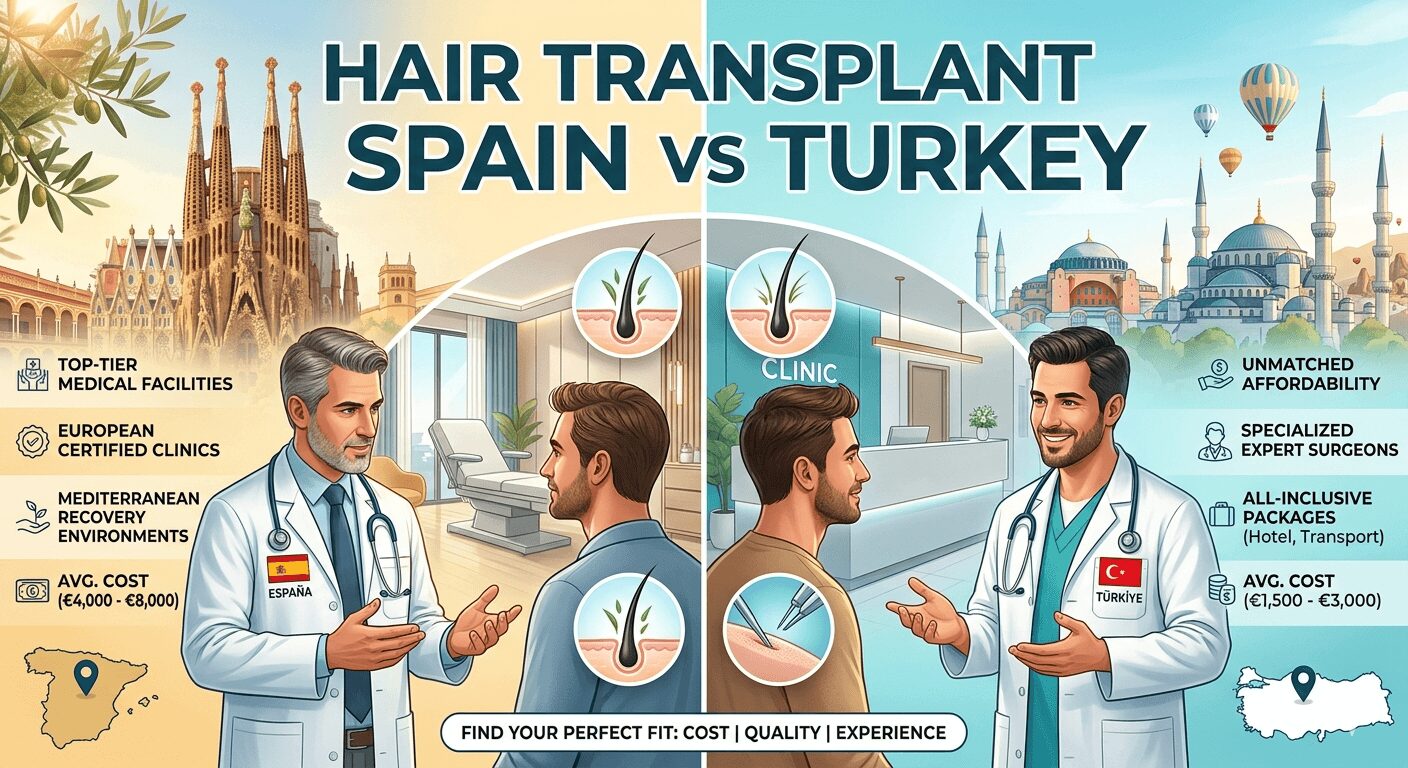
Turkish clinics have built their reputation on all-inclusive medical tourism packages. A typical FUE procedure in Istanbul runs between €1,500 and €3,000, and that price usually covers the surgery itself, airport transfers, hotel accommodation for two to three nights, and a basic medication kit. Spanish clinics operate on a different model entirely. FUE procedures in Spain range from €4,000 to €6,500, while DHI can cost €5,000 to €8,000, and those figures typically reflect the surgical fee alone. Accommodation, flights, and post-op medication are billed separately.
The per-graft pricing common in Spain means your final bill scales directly with the number of follicles transplanted. A 3,000-graft session at €3 per graft lands at €9,000 before extras. In Turkey, most clinics cap graft counts within the package price, so a 3,000-graft and a 4,500-graft procedure often cost the same.
Turkey vs Spain Hair Surgery Price: Hidden Fees and Travel Costs
The headline price from any clinic is only one piece of the puzzle. Return flights from Dublin to Istanbul average €150 to €300 depending on the season, while flights to Madrid or Barcelona sit in a similar range. The real difference emerges in on-the-ground spending. Turkish packages absorb hotel and transfer costs, whereas a three-night stay near a Spanish clinic in Madrid’s Salamanca district can add €300 to €600.
Post-operative medication, PRP booster sessions, and follow-up consultations carry separate charges in both countries. Ask every clinic for an itemized breakdown before committing. Turkey’s savings of 60-70% compared to the UK or USA hold up even after factoring in travel, but only if you verify what “all-inclusive” actually includes.
Quality of Care and Medical Standards
A lower price means nothing if the clinical outcome is poor. Both Spain and Turkey have world-class surgeons, but the regulatory environments differ in ways that matter.
Finding the Best Hair Transplant Clinic Spain Offers
Spain’s healthcare system is among the strongest in Europe, and its regulation of cosmetic surgery reflects that. A transplant in Spain is legally required to be a medical act led by a licensed surgeon, which means the person holding the implanter pen must hold a full medical degree and surgical credentials. This rule effectively eliminates the “technician-only” operations that plague less regulated markets.
Top Spanish clinics in Madrid and Barcelona invest in small-session, high-precision work. Expect detailed pre-operative density mapping, individual graft survival tracking, and a named surgeon who performs your entire procedure. The trade-off is speed: Spanish clinics often limit sessions to 2,500 to 3,000 grafts per day to maintain quality, which may require a second session for extensive hair loss.
Turkish Medical Tourism Infrastructure and Surgeon Expertise
Istanbul alone houses over 350 hair transplant clinics, and the best among them operate at a genuinely elite level. Clinics like Estenove pair board-certified surgeons with experienced technician teams, using FUE, DHI, and stem cell-assisted protocols under strict medical oversight. The city’s Şişli and Nişantaşı neighborhoods have become dedicated medical corridors, with hospitals, recovery suites, and pharmacies within walking distance.
The risk in Turkey is volume. High-throughput “hair mills” process dozens of patients daily, sometimes with surgeons rotating between operating rooms. Ask direct questions before booking: Who performs the incisions? How many procedures does the surgeon complete per day? Will the same doctor handle your entire case from consultation through extraction and implantation? A single-surgeon, single-patient-per-day model is the gold standard.
Logistics, Recovery, and Long-Term Success
Post-Operative Care and Proximity for Follow-Up Appointments
The first ten days after surgery are critical. Grafts are fragile, and infection risk peaks during this window. Spanish clinics offer an advantage for patients based in Western Europe: a two-hour flight from Dublin to Madrid means you can return for a physical follow-up at the one-week and one-month marks without significant disruption.
Turkish clinics counter this with structured virtual follow-up programs. Most reputable Istanbul clinics schedule video consultations at day three, day ten, month one, month three, and month twelve. You’ll typically be asked to photograph your recipient area under consistent lighting and send images via a dedicated patient portal.
Regardless of destination, track your own progress by taking monthly photos of your hairline and crown under the same overhead light. Expect shedding of transplanted hairs between weeks two and six, initial regrowth by month three, and meaningful density by month eight to twelve. This timeline holds for both FUE and DHI procedures.
Choosing the Right Destination for Your Procedure
The decision between Spain and Turkey comes down to your priorities. If regulatory assurance, surgeon-led procedures, and geographic proximity for follow-ups rank highest, Spain delivers on all three, though at a premium. If budget is the primary constraint and you’re willing to invest time vetting clinics, Turkey offers comparable clinical results at a fraction of the cost.
For either destination, apply these vetting criteria before booking:
- Request the lead surgeon’s medical license number and verify it independently
- Ask how many procedures the surgeon performs per day (one is ideal, two is acceptable, more is a red flag)
- Demand a full itemized cost breakdown including medication, PRP sessions, and follow-up consultations
- Confirm whether the quoted graft count is an estimate or a guaranteed minimum
- Check for “ghost surgery” risk by asking who performs extractions and who makes recipient-site incisions
Comparing a hair transplant in Spain versus Turkey isn’t about declaring a winner. It’s about matching the right clinic to your clinical needs, budget, and comfort level. Do the homework, ask the hard questions, and your results will speak for themselves.
FAQ
Irish clinics typically charge between €4,000 and €10,000 for an FUE procedure, depending on graft count and clinic reputation. Dublin-based clinics tend to sit at the higher end of that range.
For most patients, yes. The cost savings are substantial, and Istanbul’s top clinics deliver outcomes on par with European alternatives. The key is choosing a clinic with a named surgeon, transparent pricing, and a strong aftercare program.
Several Dublin clinics offer FUE and FUT procedures with board-certified surgeons. Research patient reviews on independent platforms, verify surgeon credentials through the Medical Council of Ireland, and request before-and-after galleries from the clinic directly.
Direct flights from Dublin to Istanbul take approximately four hours and are operated by multiple carriers year-round. Most Turkish clinics arrange airport pickup as part of their package. Book your consultation and surgery date at least six to eight weeks in advance to secure preferred scheduling and competitive airfares.